
[ D4T4 CRYPT ORG ]

>-Quaere Cosmos Arcana Imperii-<

  • Home
  • Phys.Org | Space News
  • arXiv.org Astrophysics \ Galaxies
  • ESA Aladin A
    • ESO Aladin B
  • Architecture
    • Architects
  • Astrophysics
    • Black Holes
  • Fine Arts
  • LINKS
    • Star Gazing UK Blog
    • In The Sky: Sky Atlas
  • Linux
    • Man Pages
  • Cinema
    • Film Noir
    • Notable Film Directors
  • UFO / UAP: INDIGO X-RAY FOXTROT

Black Hole @ Milky Way Galactic Center via allWISE Infrared

April 7, 2019 by blogadmin

Share2
Buffer
Pocket
Tweet
Reddit
WhatsApp
Pin
Email
Share
2 Shares

Sagittarius A or M87?

OK, since everyone’s talking about the upcoming April 10th event: “Scientists set to unveil first picture of a black hole“. (Thanks to Roy ChangLeo for the tip on this one.)

In the mean time, how about a quick peek into the galactic center of the Milky Way, aka Sagittarius A?

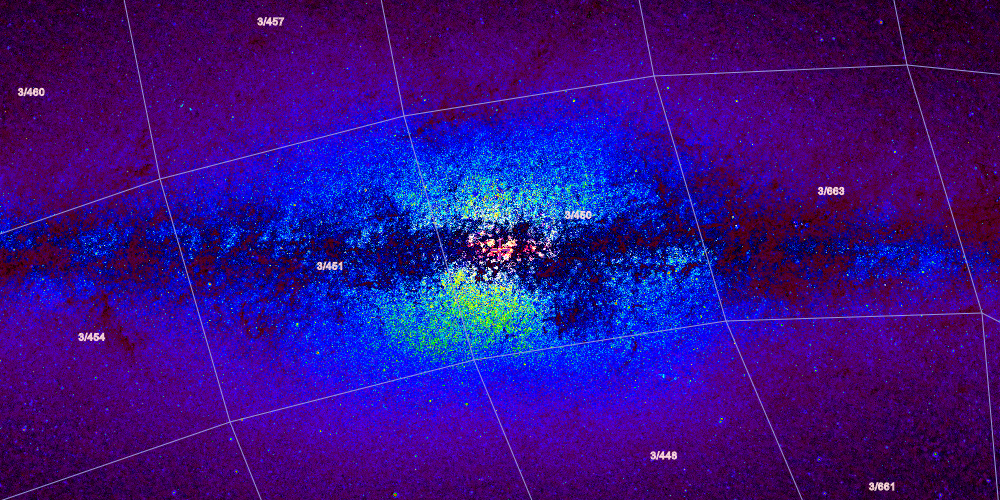
Here’s an interactive pic in INFRARED spectrum of our own galactic center, Sagittarius A.

If you click zoom enough times and allow the system to render the images, you will eventually come upon a dark object, all black.
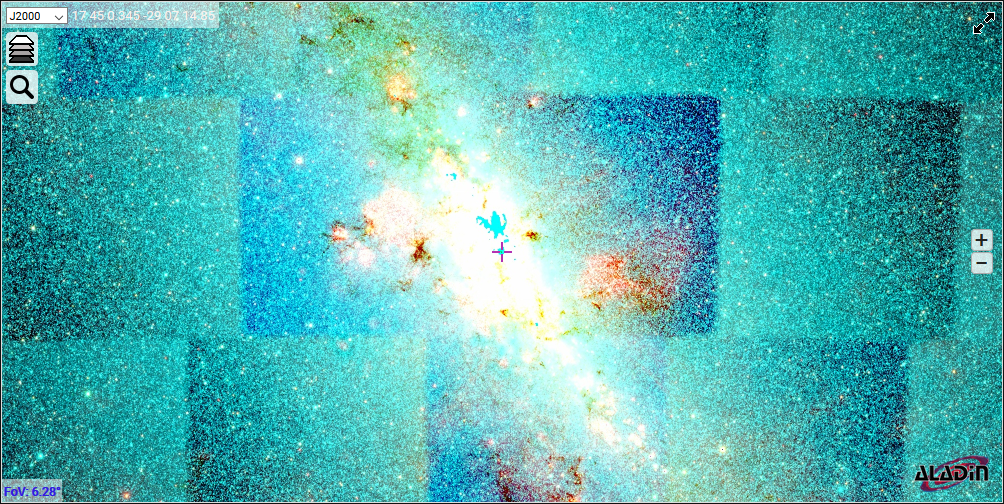
As you zoom in, it’ll look like this:

Then it’ll look like this, that’s it, a giant dark zone revealed by infrared.  Predator would be proud!
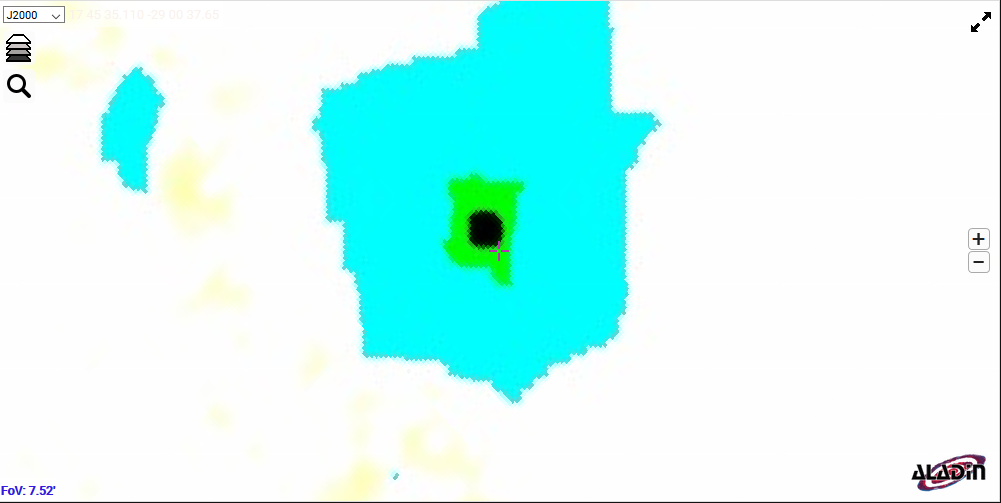
As you zoom far enough into the black hole, it’s as we always suspected:

ALADIN LITE ON STEROIDS – THE ESA VERSION:

The European Space Administration [ESA] has a heavily optimized and dialed in version of ALADIN Lite live, right here. It has a ton more features and data built in.

For those of you who want to keep it simple and have a Windows machine, click here to download ALADIN for Windows.

ALADIN View Options:

If you want to see different views of our galaxy, just click on the settings on upper left, where you can either alternate the given view to J2000d, and GAL (sidelong), or select one of the many base image formats, or search for another object.:

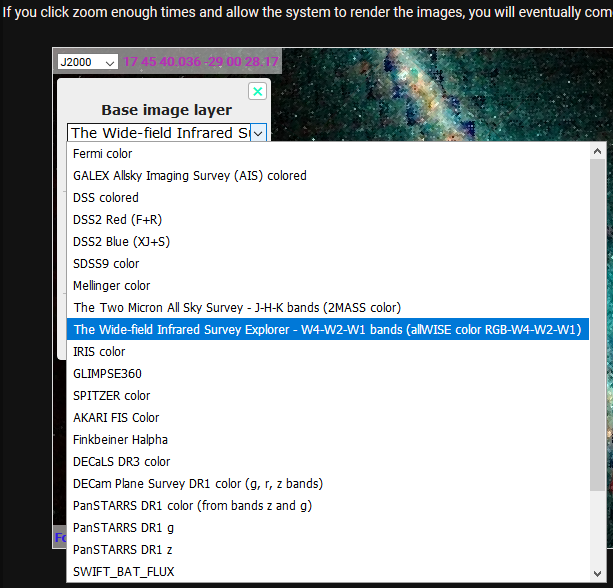
This will get you the other views:
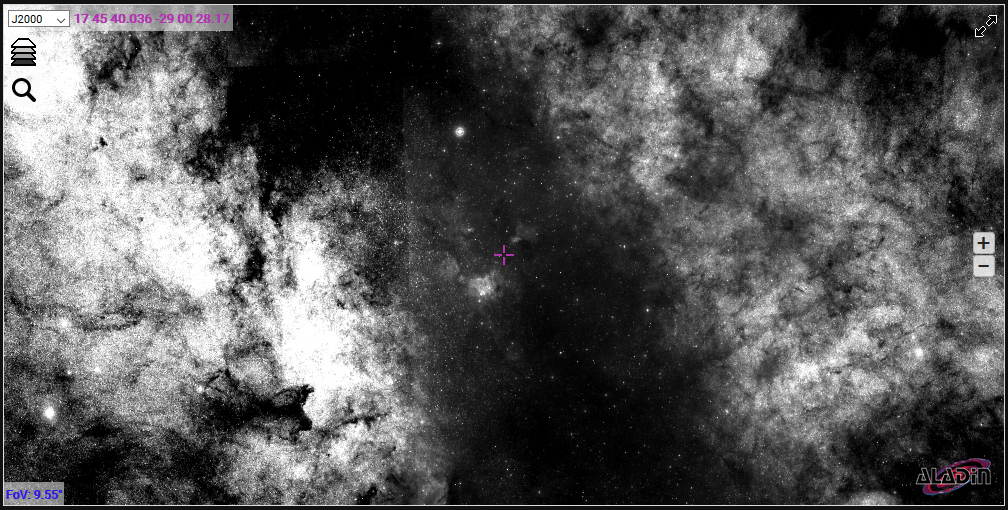
And here’s another:
ALADIN LITE via WordPress / Javascript:

This object (aside from Curley Joe) is rendered by the Aladin Lite SKY ATLAS tool’s Javascript API.

I used this Howto to get past some of the initial limitations in WordPress:

https://www.wpbeginner.com/wp-tutorials/how-to-easily-add-javascript-in-wordpress-pages-or-posts/

The HOWTO has a section “Method 3. Adding Javascript Code Inside Posts or Pages Using Plugin”, that’s the part I used, with this plugin: CODE EMBED by David Artiss

I checked out the tutorial, then checked the API Examples.

I liked this API Code example of a visualization of MARS a lot, so much so I made a separate Mars Planetary Data page for it. I even figured out how to stop it from going into full-screen automatically.
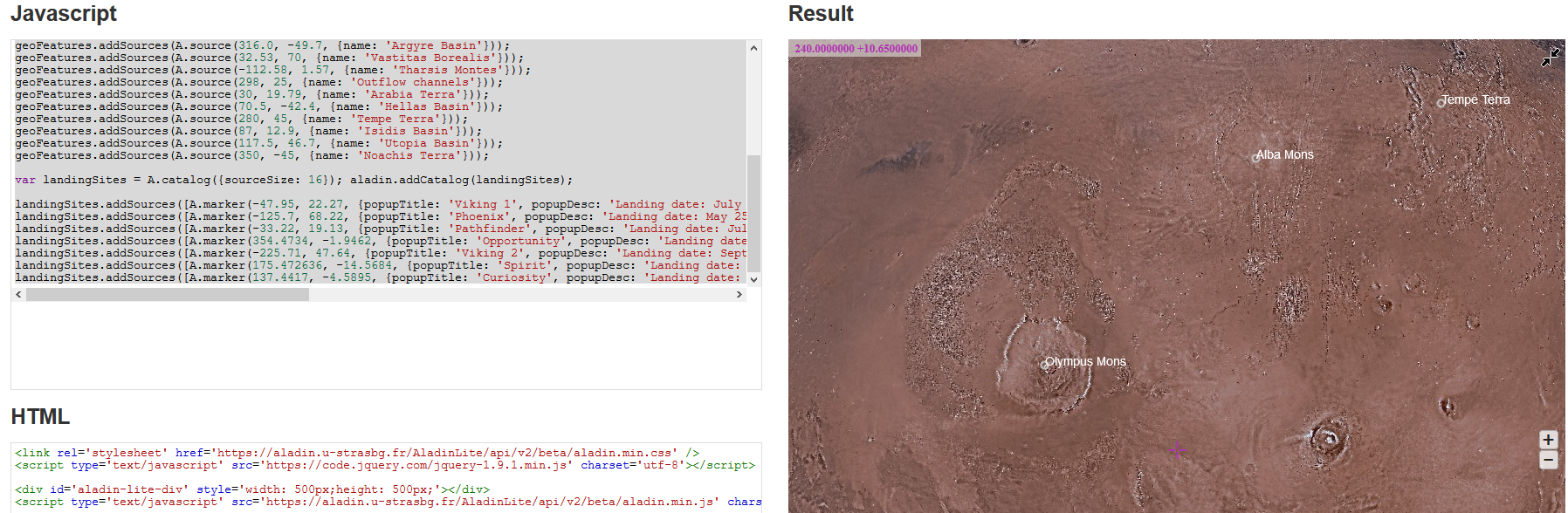
Using ATOM Code Editor Helped A Lot:

Other issues I ran into were code related.

So I opened up the free code editing tool known as ATOM which you can download here, and started saving the code into various HTML files, like this one for a Galaxy Pair.
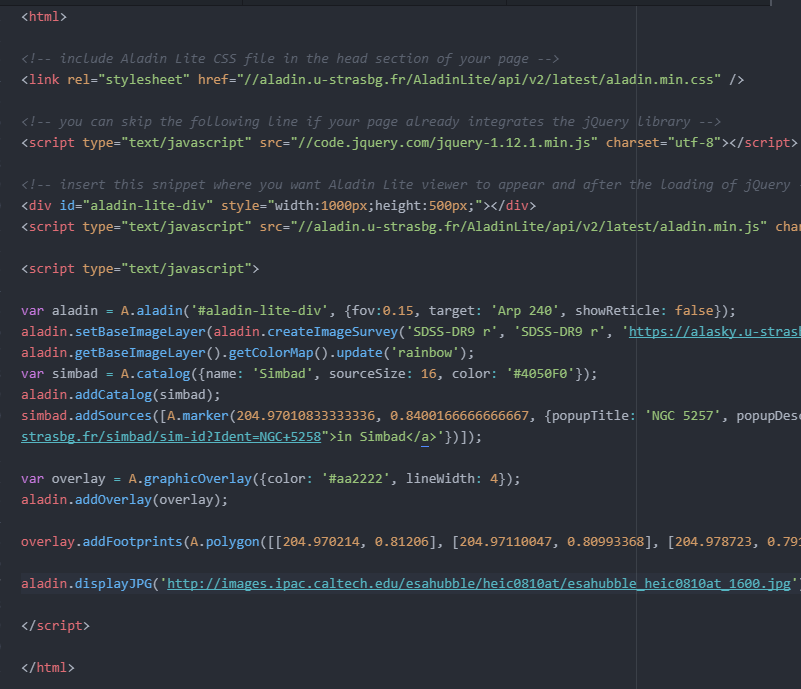
Once I started dumping those into the right custom fields, I started getting results.

I haven’t solved the [CSS?] mystery as to why it works better in Widgets than in static posts, but I will.

I’ll even clone some or all of this ALADIN howto info into a separate post or posts.

Share2
Buffer
Pocket
Tweet
Reddit
WhatsApp
Pin
Email
Share
2 Shares

Filed Under: Black Holes, DataCrypt

SCI-NEWS.com

  • VISTA Focuses on Inner Regions of Magellanic Clouds
    by Natali Anderson on September 16, 2026 at 3:57 pm

    Astronomers using ESO’s Visible and Infrared Survey Telescope for Astronomy (VISTA) have observed the densest, most crowded regions at the centers of the Large and Small Magellanic Clouds, our […]

  • New Dicynodont Species from Tanzania Suggests Younger Age for Rocks Tied to Earliest Dinosaurs
    by Enrico de Lazaro on September 15, 2026 at 11:04 pm

    Paleontologists have identified a new species of ancient, distant mammal relative from two fossil specimens found decades apart in the Manda Beds of Tanzania. The post New Dicynodont Species from […]

  • Entanglement Survives Violence of CERN’s Large Hadron Collider
    by News Staff on September 15, 2026 at 9:06 pm

    Physicists from the ATLAS Collaboration at CERN’s Large Hadron Collider have confirmed that quantum entanglement -- the phenomenon Albert Einstein called ‘spooky action at a distance’ -- can […]

  • New Study Explains Why Venus Has No Moon
    by Natali Anderson on September 15, 2026 at 6:38 pm

    Dr. Stephen Kane from the University of California, Riverside and colleagues offer a tidy explanation for one of the Solar System’s enduring puzzles: why Venus, so similar to Earth in size and […]

  • Spanish Amber Deposit Offers Rare Window into Cretaceous Life
    by Enrico de Lazaro on September 14, 2026 at 10:33 pm

    El Soplao, a fossil site tucked into the hills of Cantabria in northern Spain, stands out for yielding amber pieces with a blue-violet hue and abundant bioinclusions, according to a new review […]

  • Diplodocus, Long Thought Exclusively American, Turns Up in Spain
    by Enrico de Lazaro on September 14, 2026 at 9:17 pm

    Paleontologists from Fundación Dinópolis have identified the first confirmed fossils of the genus Diplodocus found outside North America. The post Diplodocus, Long Thought Exclusively American, […]

  • Mercury Has Shrunk Even More than Planetary Scientists Thought
    by News Staff on September 14, 2026 at 6:41 pm

    The Solar System’s smallest planet has contracted by nearly 19 km (12 miles) across, as crater debris masked telltale wrinkles on its surface, according to new research led by the German Aerospace […]

  • Devonian Armored Fish Show Multiple Ways to Crush Hard-Shelled Prey
    by Enrico de Lazaro on September 14, 2026 at 5:01 pm

    Long before sharks or reptiles ruled the seas, armor-plated fish called placoderms were already experimenting with different jaw designs to crush hard-shelled prey. The post Devonian Armored Fish […]

  • Study: Interstellar Comet 3I/ATLAS Formed in Cold, Nitrogen-Rich Environment
    by Enrico de Lazaro on September 14, 2026 at 2:43 pm

    Astronomers have found new evidence that 3I/ATLAS, only the third confirmed interstellar object ever detected entering the Solar System from beyond, formed in an extremely cold environment far from […]

  • Ancient Alligator Relative Lived Right After Dinosaur-Killing Asteroid
    by Enrico de Lazaro on September 11, 2026 at 11:14 pm

    Paleontologists have identified a new species of extinct alligatorid that lived in what is now Colorado just a few hundred thousand years after the asteroid impact that wiped out the non-avian […]

  • Ichthyosaurs Had Surprisingly Dense Ribs, New Study Finds
    by Enrico de Lazaro on September 11, 2026 at 4:54 pm

    New research from the Natural History Museum at the University of Oslo suggests ichthyosaurs’ rib cages may have done a job modern whale ribs don’t: acting as ballast to help them dive. The post […]

  • Exceptionally Preserved Bird Feathers Found in 66-Million-Year-Old Dinosaur Coprolite
    by Enrico de Lazaro on September 10, 2026 at 10:08 pm

    Paleontologists in Montana have discovered remarkably preserved feathers of an ancient aquatic bird inside a fossilized dinosaur dropping, offering rare insight into why certain birds survived the […]

  • Denisovans Once Roamed Southwest China, New Fossils Reveal
    by Enrico de Lazaro on September 10, 2026 at 7:01 pm

    Paleoanthropologists have identified a trove of Denisovan fossils from a cave in China’s Yunnan province, extending the known range of the elusive human relative and providing the first-ever direct […]

  • Paleontologists Discover First-Ever Adult Tyrannosaurus rex Trackway
    by Enrico de Lazaro on September 9, 2026 at 11:04 pm

    Paleontologists in North Dakota have unearthed a set of 66.5-million-year-old fossilized footprints that can be confidently attributed to a full-grown Tyrannosaurus rex. The post Paleontologists […]

  • Elephants Show Talent for Resisting Impulses
    by News Staff on September 9, 2026 at 8:45 pm

    In experiments in Thailand, Asian elephants (Elephas maximus) learned to ignore an enticing but ineffective route to food and quickly adapted when a familiar solution stopped working. The post […]

  • Britain’s Tallest Standing Stones Traced to Their Geological Source
    by Enrico de Lazaro on September 9, 2026 at 7:26 pm

    Scientists from Curtin University and the University of York have pinpointed the origin of the Devil’s Arrows, the three towering gritstone megaliths that have stood on the edge of Boroughbridge, […]

  • Researchers Unveil Complete Fruit Fly Connectome
    by Enrico de Lazaro on September 9, 2026 at 5:23 pm

    After nearly two decades of work, scientists have completed a wiring diagram of the central nervous system of an adult male fruit fly (Drosophila melanogaster). The post Researchers Unveil Complete […]

  • Hubble and Webb Team Up to Spy Tiny Frozen Worlds beyond Neptune
    by Enrico de Lazaro on September 9, 2026 at 3:35 pm

    For the first time, astronomers combined Hubble and Webb space telescopes to hunt down some of the smallest, faintest objects ever spotted in the outer Solar System. The post Hubble and Webb Team Up […]

  • New Owl Species Discovered in Peru
    by Enrico de Lazaro on September 8, 2026 at 10:59 pm

    A horned owl living in a narrow strip of high-Andean grassland in northern Peru is a species new to science, according to a paper published in July 2026 in the journal Audiornis. The post New Owl […]

  • Could Scoop of Moon Dust Reveal Alien Technology?
    by Sergio Prostak on September 8, 2026 at 8:54 pm

    A cubic meter of lunar soil might be one of our best bets for finding physical proof that another advanced civilization once existed somewhere in the Milky Way, according to a new paper to be […]

Copyright © 2026 · Dynamik-Gen on Genesis Framework · WordPress · Log in