
[ D4T4 CRYPT ORG ]

>-Quaere Cosmos Arcana Imperii-<

  • Home
  • Phys.Org | Space News
  • arXiv.org Astrophysics \ Galaxies
  • ESA Aladin A
    • ESO Aladin B
  • Architecture
    • Architects
  • Astrophysics
    • Black Holes
  • Fine Arts
  • LINKS
    • Star Gazing UK Blog
    • In The Sky: Sky Atlas
  • Linux
    • Man Pages
  • Cinema
    • Film Noir
    • Notable Film Directors
  • UFO / UAP: INDIGO X-RAY FOXTROT

Oil Painting Videos: Yasser Fayad

August 9, 2019 by blogadmin

Share
Buffer
Pocket
Tweet
Reddit
WhatsApp
Pin
Email
Share
0 Shares

In the line of videos I have been watching I have found one guy who’s videos I like and who displays a good sense of touch, using different hand angles.

Also his approach is very simplified, just using a very standard palette board and a limited selection of colors.  Yet he makes the most of it.

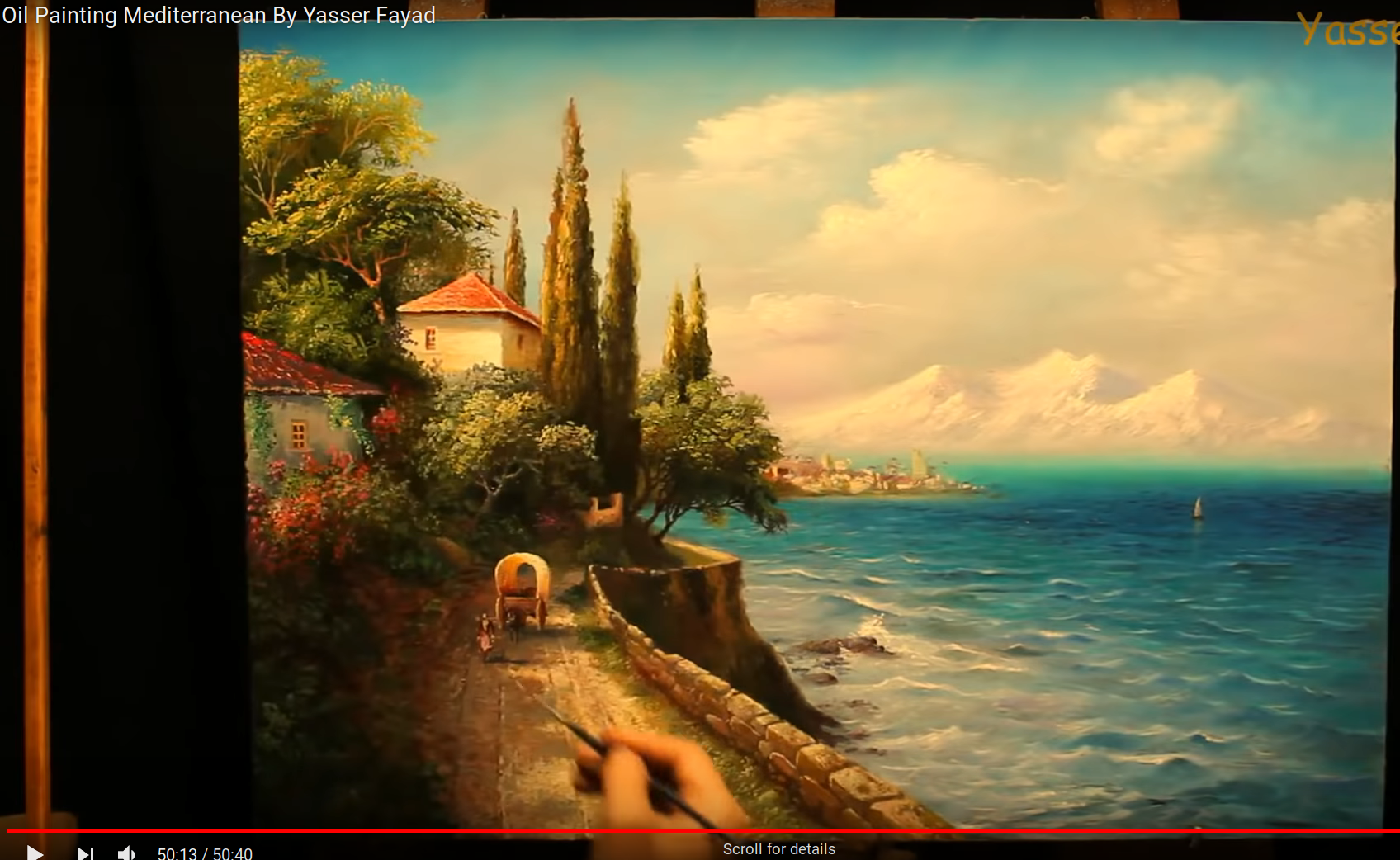
I don’t paint in this style and I generally don’t like brush strokes to show, but the point for me here is his overall composition, and how he has sped up the video to cover the whole process from start to end.

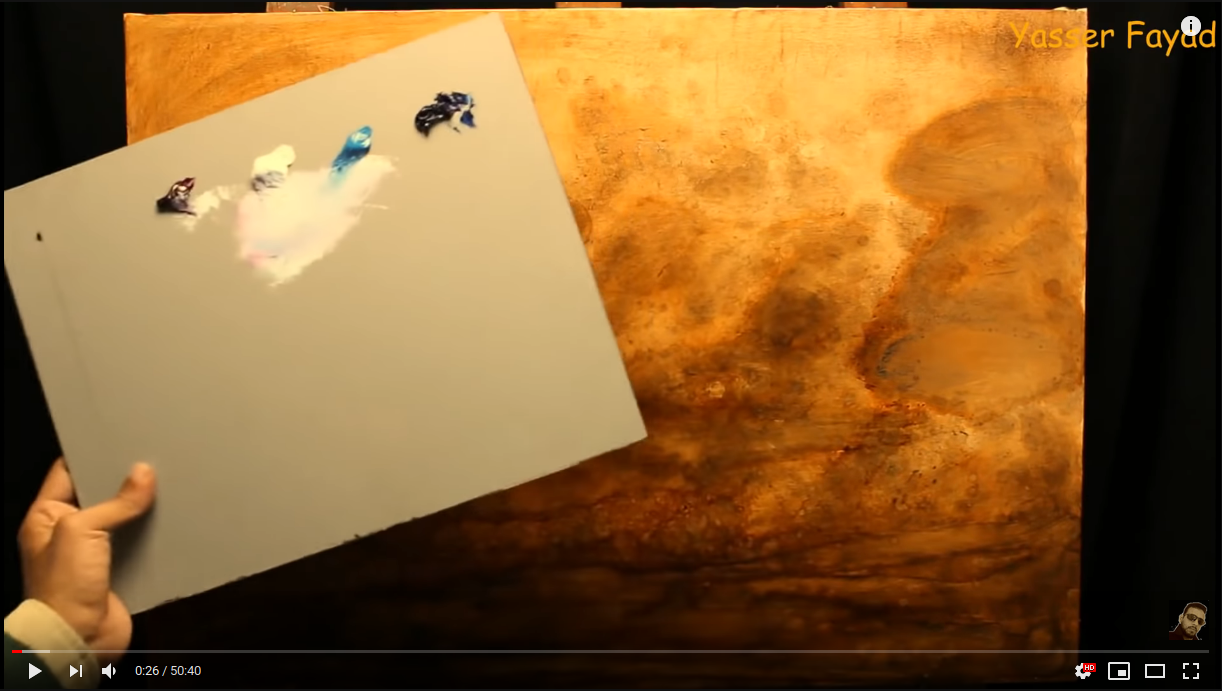
He starts with this.
And he finishes as follows.
He does another small one of Cairo.

Goes here like this for all the brightly lit areas…

And then this for the start of the shadows…

The edits many of the surfaces to be lighter mostly via thicker paint. Again, not a style I paint in but I respect that this version of “painterly” “brush-strokey” work is what the medium was most suited to for so many years.

It’s good to keep in mind this limit of sorts, as once one gets into less brush strokes showing, and more intensity by way of glazes, you are entering a world where physics of light, chemistry of color, and spatial rendering end up better done in an electronic or photographic medium.

I skip forward to where he has also added more features, and then added light upon the whole scene via white.

Then he’s onto adding the rest of the detailed features such as figures, and a tunes into a general sense of where the sunlight is coming from.
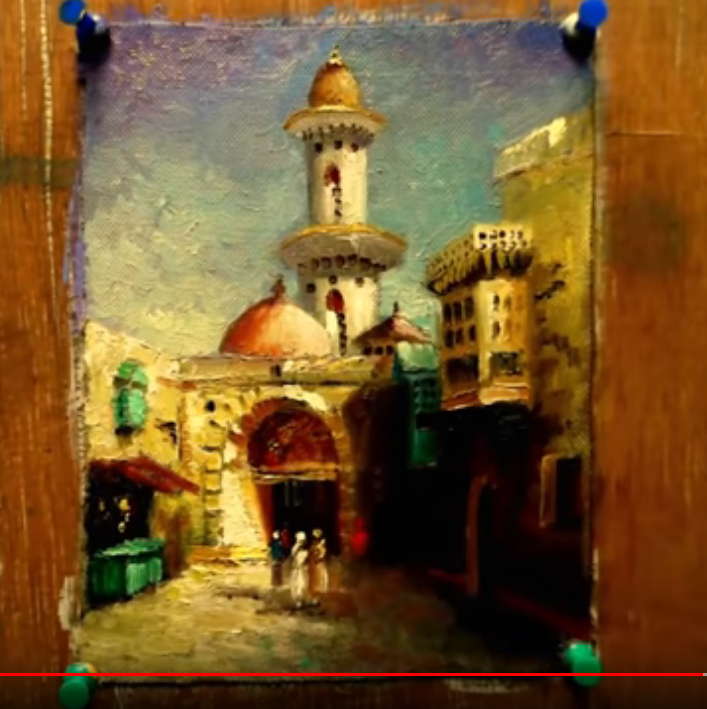
More figures, more details, more light correction… I will always like the depth and tone of oil for this reason, -even at this small scale the umber, reds, ochre, create a lot of foundation for the textile colors / inks such as are in the clothing and green building features. It would be hard to know without further checking what a realistic palette of such a scene would be, -but this isn’t realism. It’s definitely the next best thing.

He finishes with a wave of light across the whole work and signs it.

This is a good example of light and shadow, earth tones, and something a bit less boring than landscapes.

Many lessons can be learned on the basics of rendering a “tall” “portrait” with all 3 dimensional aspects touched upon.


Share
Buffer
Pocket
Tweet
Reddit
WhatsApp
Pin
Email
Share
0 Shares

Filed Under: Fine Arts, Oil Paintings

SCI-NEWS.com

  • Ornithologists Identify Cryptic New Bird Species in Japan
    by Natali Anderson on March 18, 2026 at 1:47 am

    Genetic and acoustic evidence show that the rare Ijima’s leaf warbler (Phylloscopus ijimae) is actually two distinct bird species, including the newly-identified Tokara leaf warbler -- both with […]

  • Oviraptors May Have Needed the Sun to Hatch Their Eggs
    by News Staff on March 17, 2026 at 11:42 pm

    New experiments indicate bird-like oviraptorid dinosaurs could not fully warm their eggs with body heat alone, instead combining brooding with solar warmth in semi-open nests. The post Oviraptors May […]

  • DNA’s Building Blocks May Have Arrived from Space, Asteroid Ryugu Samples Suggest
    by News Staff on March 17, 2026 at 9:42 pm

    Samples returned by JAXA’s Hayabusa-2 mission from the C-type asteroid (162173) Ryugu contain all five canonical nucleobases -- purines (adenine and guanine) and pyrimidines (cytosine, thymine and […]

  • Early Triassic Cyclidan Crustacean Had Powerful Jaws
    by Enrico de Lazaro on March 17, 2026 at 1:51 am

    Paleontologists have described a new species of enigmatic cyclidan crustacean on the basis of three well-preserved specimens from the Early Triassic Guiyang biota of China. The post Early Triassic […]

  • Neanderthals May Have Hunted Giant Elephants that Roamed across Prehistoric Europe
    by Enrico de Lazaro on March 16, 2026 at 11:16 pm

    Chemical clues preserved in the teeth of straight-tusked elephants (Palaeoloxodon antiquus) from the 125,000-year-old site of Neumark-Nord in Germany suggest these massive animals traveled hundreds […]

  • New Kind of Planet May Lurk in Milky Way: Extreme World of Magma and Sulfur
    by News Staff on March 16, 2026 at 8:25 pm

    New observations of L 98-59d, a member of the five-planet system L 98-59, suggest it harbors a vast global magma ocean that traps sulfur deep inside, forming a previously unrecognized class of […]

  • Tropical Bush Cricket’s Hot-Pink Phase May Be Nature’s Perfect Disguise
    by Natali Anderson on March 16, 2026 at 6:31 pm

    Entomologists in Panama have observed a leaf-masquerading katydid species that begins life bright pink before turning green days later, a shift that may mimic rainforest leaves that flush red or pink […]

  • Supergiant Star Makes Rare Leap to Hotter Phase, Astronomers Say
    by News Staff on March 16, 2026 at 12:10 pm

    Long-term observations of WOH G64 -- once considered the most extreme red supergiant star in its galaxy -- reveal that the star has undergone a dramatic transition, possibly shedding part of its […]

  • Sun May Have Escaped Milky Way’s Crowded Core Billions of Years Ago
    by News Staff on March 14, 2026 at 12:55 am

    Using a vast catalog of Sun-like stars built by ESA’s Gaia mission, astronomers have found strong evidence that our home star traveled outward with thousands of stellar counterparts roughly 4 to 6 […]

  • New Fossil Crocodile from Ethiopia Lived alongside Australopithecus afarensis
    by News Staff on March 13, 2026 at 3:31 am

    Paleontologists analyzing fossils from Ethiopia have described a previously unknown crocodile species that shared the landscape with a hominid species called Australopithecus afarensis. The post New […]

  • Early Howler Monkeys Adapted to Eating Leaves 13 Million Years Ago
    by News Staff on March 12, 2026 at 2:38 am

    Fossil jaws of the ancient monkey species Stirtonia victoriae from the La Victoria Formation in Colombia suggest that a shift toward leaf-eating allowed early primates in South America to grow larger […]

  • Astronomers Witness Aftermath of Catastrophic Planetary Collision
    by News Staff on March 11, 2026 at 10:08 pm

    An unusual flickering of a young F-type star called Gaia20ehk and an expanding cloud of dust around it suggest that a catastrophic planetary crash unfolded in real time, offering a rare glimpse of […]

  • New Research Links Daily Multivitamins to Slower Biological Aging
    by News Staff on March 11, 2026 at 7:42 pm

    In a randomized clinical trial of older adults, researchers found that taking multivitamins for two years modestly slowed epigenetic markers of aging -- equivalent to roughly four months less […]

  • Astronomers Observe Neutron Star Crash in Unexpected Environment
    by News Staff on March 11, 2026 at 5:19 pm

    Using NASA’s Chandra X-ray Observatory and other telescopes, astronomers have traced a short-duration gamma-ray burst event called GRB 230906A to a faint dwarf galaxy embedded in a vast stream of […]

  • Study: Raccoons Don’t Just Solve Puzzles for Food, They Do It for Fun
    by News Staff on March 11, 2026 at 3:30 pm

    In a new study led by University of British Columbia Ph.D. student Hannah Griebling, raccoons (Procyon lotor) continued manipulating complex puzzle boxes long after retrieving the only marshmallow […]

  • 275-Million-Year-Old Amphibian Relative with Twisted Jaws Rewrites Early Tetrapod Diets
    by News Staff on March 11, 2026 at 1:15 am

    A new genus and species of archaic stem tetrapod from the Permian period has been identified from fossil jawbones found in Brazil. The post 275-Million-Year-Old Amphibian Relative with Twisted Jaws […]

  • Ancient Parrot DNA Points to Pre-Inca Animal Trade
    by News Staff on March 11, 2026 at 12:25 am

    Ancient DNA from brightly colored feathers found in Peru shows that at least four distinct species of Amazonian parrots -- the scarlet macaw (Ara macao), the blue-and-yellow macaw (Ara ararauna), the […]

  • VLT Discovers Third Gas Cloud near Milky Way’s Central Black Hole
    by Enrico de Lazaro on March 10, 2026 at 10:27 pm

    The newly-identified gas cloud, dubbed G2t, follows nearly the same orbit as two known clouds, suggesting they were all expelled by a pair of massive stars near the core of our Milky Way Galaxy. The […]

  • Two New Bird Species Identified in Amazonia
    by Natali Anderson on March 10, 2026 at 1:09 am

    An antbird long thought to be a single widespread species across the Amazon rainforest is, in fact, several different ones. Among them are two newly-described species -- Cercomacra mura and […]

  • 3I/ATLAS is Unusually Rich in Methanol, ALMA Observations Show
    by News Staff on March 9, 2026 at 10:26 pm

    Astronomers using the Atacama Large Millimeter/submillimeter Array (ALMA) have detected hydrogen cyanide (nitrogen-bearing organic molecule commonly seen in comets) as well as unusually high levels […]

Copyright © 2026 · Dynamik-Gen on Genesis Framework · WordPress · Log in