[ D4T4 CRYPT ORG ]

>-Quaere Cosmos Arcana Imperii-<

  • Home
  • Phys.Org | Space News
  • arXiv.org Astrophysics \ Galaxies
  • ESA Aladin A
    • ESO Aladin B
  • Architecture
    • Architects
  • Astrophysics
    • Black Holes
  • Fine Arts
  • LINKS
    • Star Gazing UK Blog
    • In The Sky: Sky Atlas
  • Linux
    • Man Pages
  • Cinema
    • Film Noir
    • Notable Film Directors
  • UFO / UAP: INDIGO X-RAY FOXTROT

Silver Moon: Update 3/2/20

March 2, 2020 by blogadmin

Share
Buffer
Pocket
Tweet
Reddit
WhatsApp
Pin
Email
Share
0 Shares

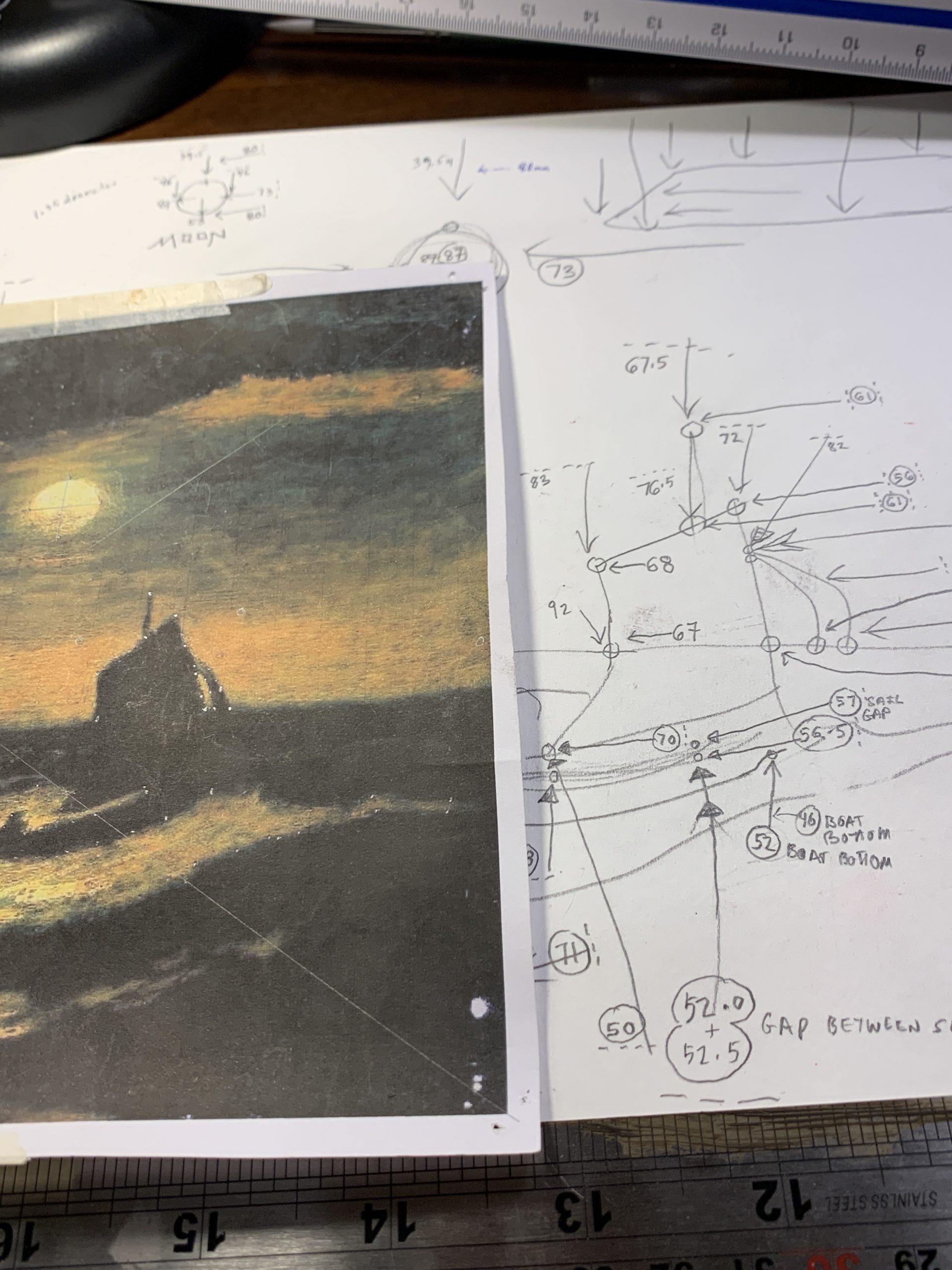
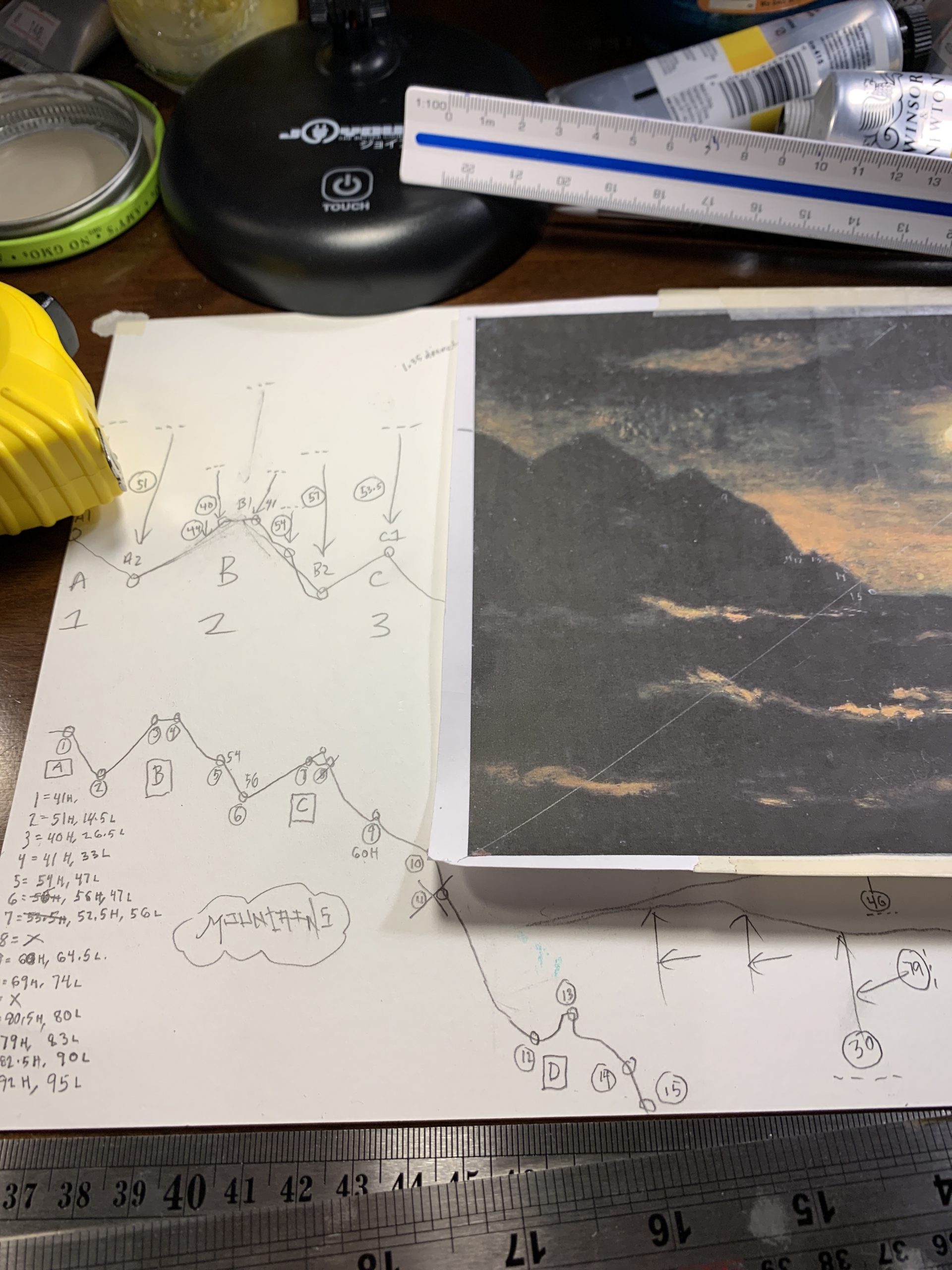
I was able to spend a Sunday afternoon with my daughters in the studio and while they drew their stuff I was able to map out the coordinates of the objects in this painting.

It is painstaking work but I am learning a lot about how this painter arranged everything.

The sketching might look a bit haphazard but don’t let that fool you the coordinates are accurate to the millimeter.
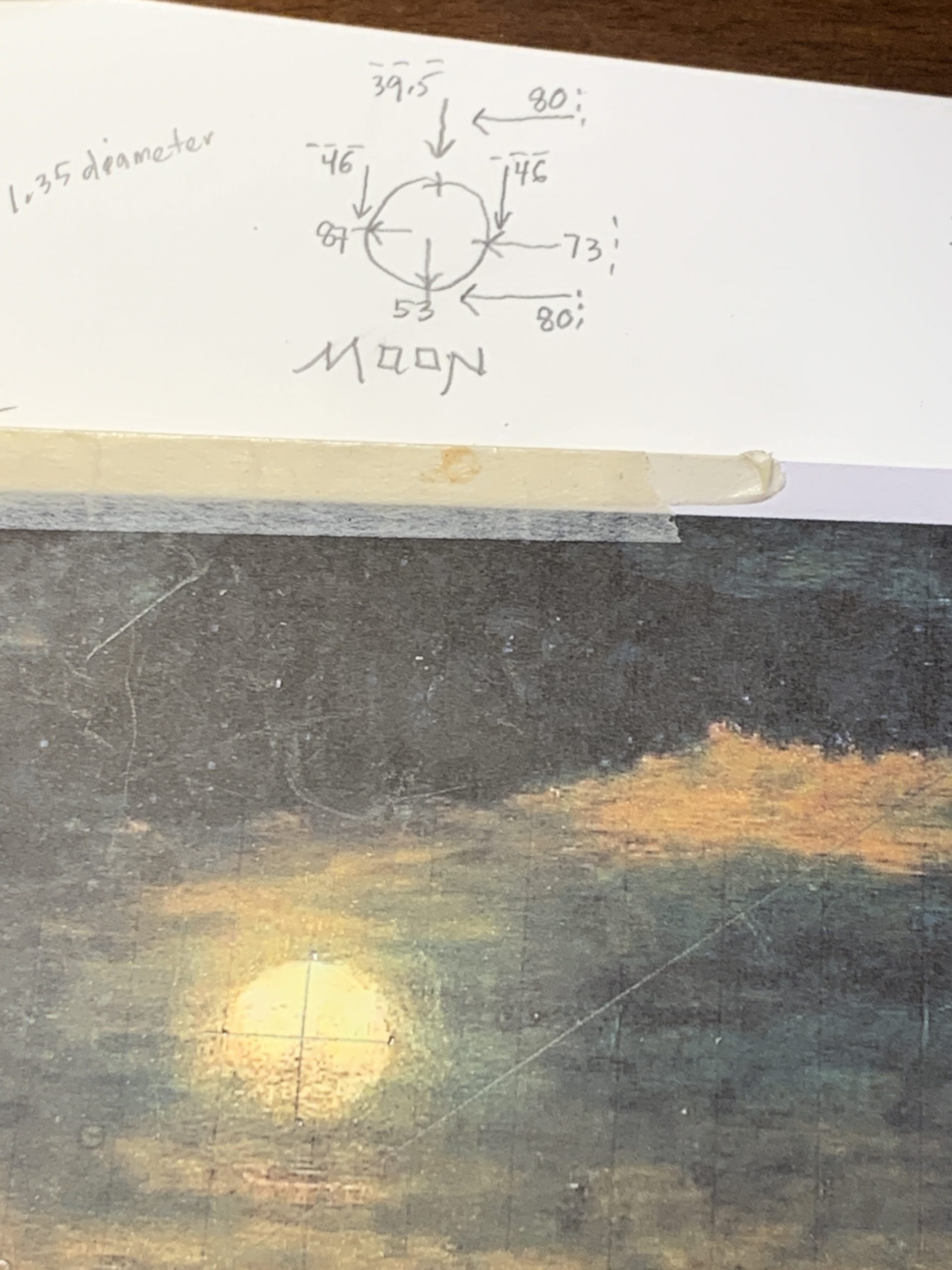
I was able to get the diameter of the moon as well as it’s X and Y coordinates otherwise known as latitude and longitude.

There is a technique to do this which I will describe in a separate article so that you do not have to use an opaque projector.

I was also able to get the X and Y coordinates of all the mountain peaks and cliffs, as well as the position of the sailboat and it’s orientation above, at, and below the horizon line, and the perceived shoreline, @ viewer position.

I have actually rendered the basics of the moon and the top mast and main sail. They came up in pretty accurate position all things considered.
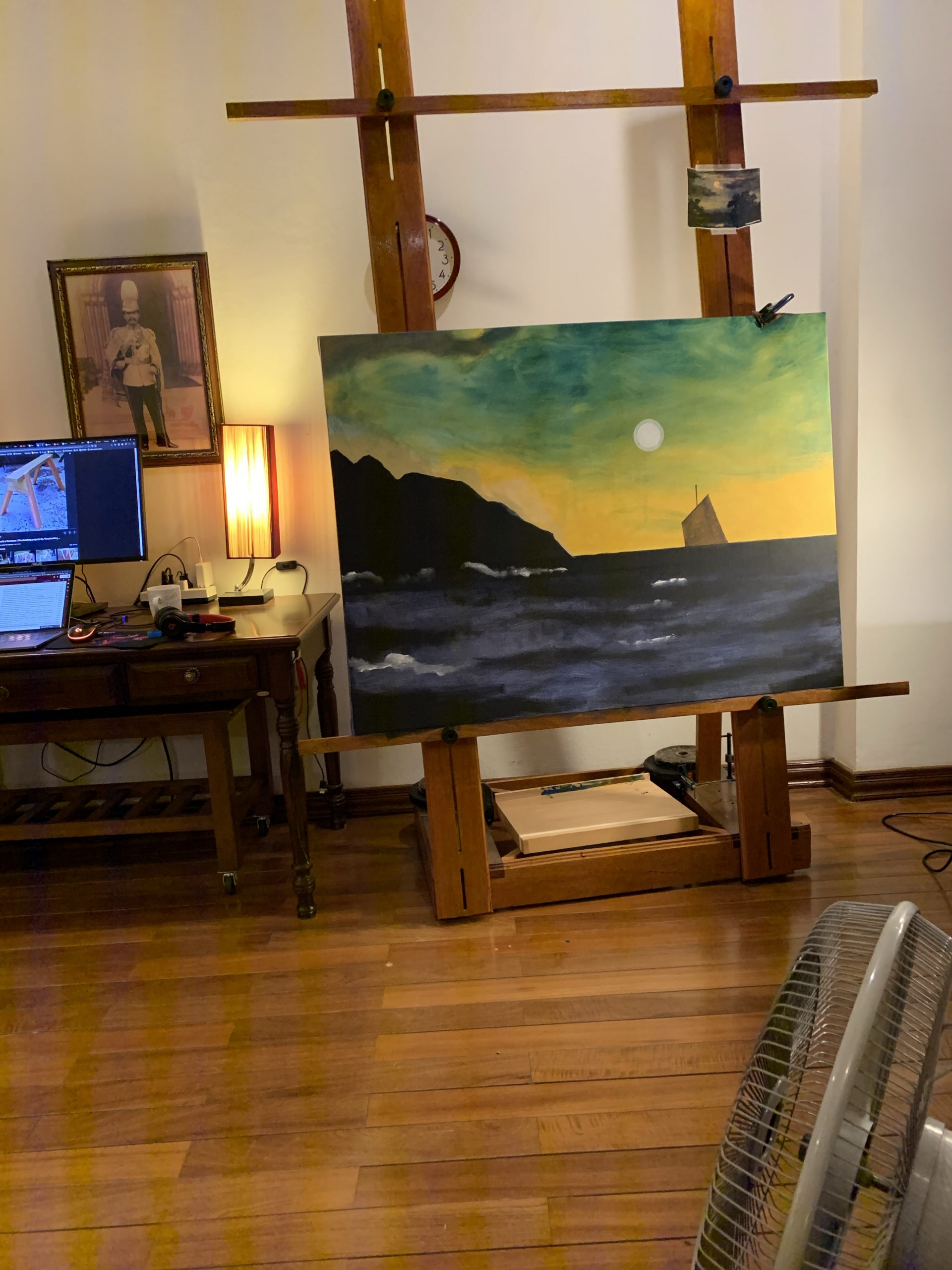
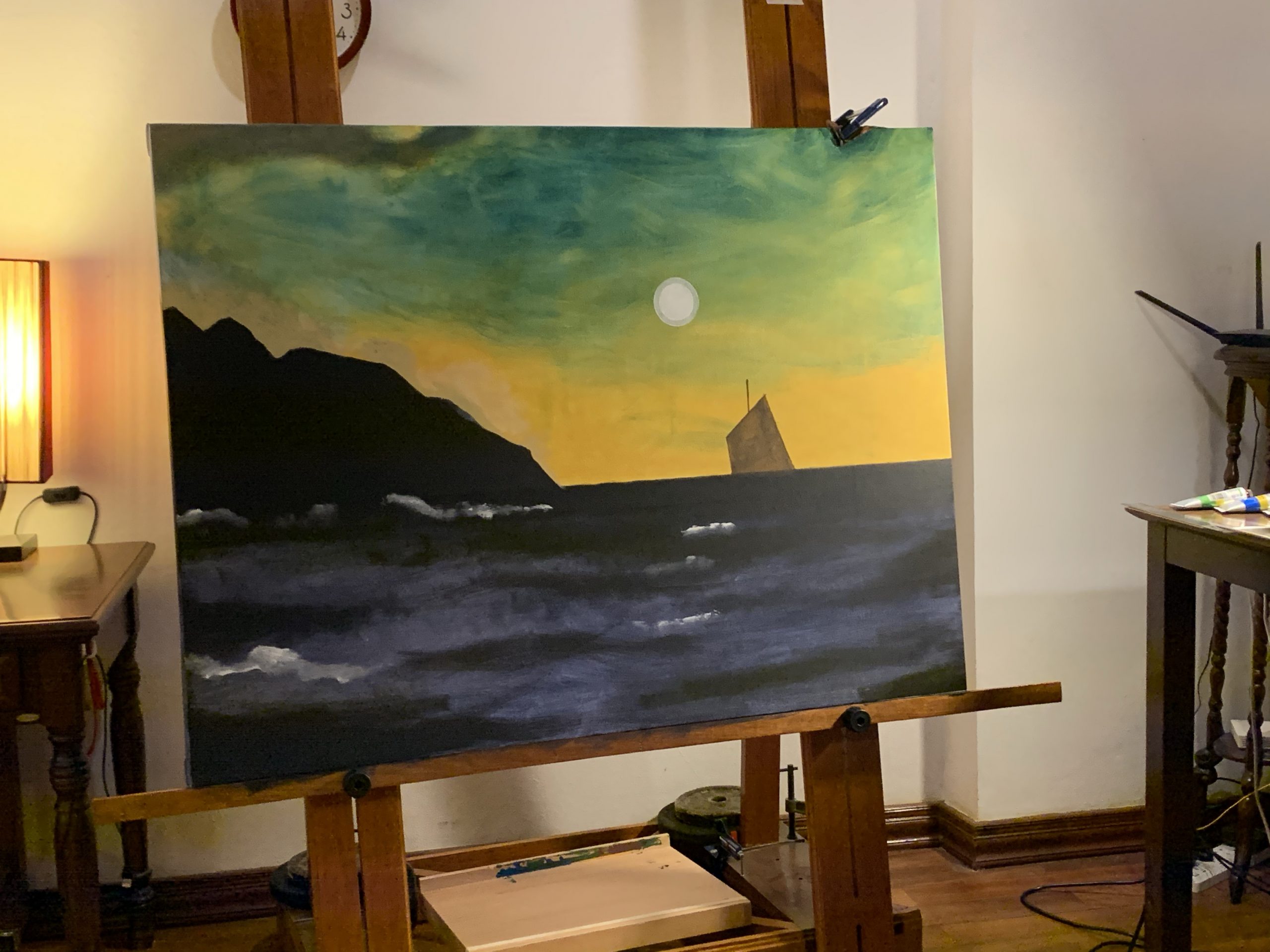
This canvas is exactly 583x the scale of the reference drawing.

I am using Google sheets to convert X height from top edge and Y width inwards from right edge for the bottom right corner of the main sail where it meets the horizon line.

Here’s the coordinate in original (reference drawing in cm.m and it’s converted scaled value (on canvas) in cm.m.
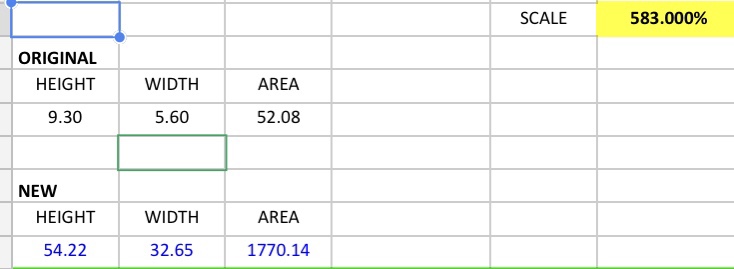
As noted above I will share the exact technique for this process most likely in a YouTube video once I get the script written.

I’d also like to give credit to my engineer friend JD in the video as well as the corresponding web posting for coming up with the simplest formula in answer to an email I wrote him.

You might ask: “why study another artist?”

My best answer is that with regard to oil painting there are quite a few related disciplines within fine arts and illustration that lead to solid work versus days weeks or even months of constant reworking of mistakes.

In oil paintings the chemistry of each layer has to relate properly to the layers around it above it and below it. The chemistry of the oil paint out of the tube differs from color to color due to the chemical elements used to manufacture the given color. Also within the tube there are several other ingredients which also differ in terms of how they dry, shrink, bleed, and otherwise interact with neighboring colors.

And that’s just the color in the tube, without regard for the solvents used, or expanders used, such as Linseed Oil, or stand oil.

So the technical answer to why study someone else’s work in this particular post is given with the reader also keeping in mind that this work is being done presently in acrylic to rule out the chemistry of oils and just focus on the other part of the answer which is one of drawing and perspective, positive and negative space, color, light, shadow, and other factors.

Starting out with an artist who has done work that can be studied easily as a way to build up all of the skills and gain an understanding everywhere needed in technical and chemistry areas. 

There is also quite a bit of aesthetic enjoyment as one begins to solve the hidden formula with regard to how the artist laid out this work overall. 

All of this contributes toward a future understanding of how to produce original independent work of one’s own that contains all of the more advanced skills one would need to impress an audience or get a message, impression, concept or mood across.

My answer might not be good enough for some people but consider it from another angle: That of an architect, that of a chef, that of a pilot, or even that of a brain surgeon. Or even simpler a student driver of a car, in a given city.

You can’t just hop into a car and go to a specific destination if you’ve never driven before. You can’t design a building, bake a cake, fly an airplane, or do brain surgery without studying.

The same applies with regard to drawing and painting and learning from the Masters. There are many reasons why their work was considered superior even centuries after they passed on. One would do well to understand the accomplishments of those who came before them.

It’s not a matter of loyalty, it’s a matter of detail.

One must practice in all disciplines, even the most simple. Practice builds experience and situational awareness.

While some regard to fine arts as a play pen, I regard them as a place where many different scientific, mathematical, and aesthetic devices come into play.

Be it chemistry of light and color with regard to working with dyes, pigments, inks or paints, or the mathematics of geometry (perspective) or the basic algebra of calculating latitude and longitude coordinates at multiple scales or units of measurement, or the aesthetic and creative endeavors of inventing three-dimensional spaces in which one can render anything, -these are my preferred, perhaps “old-fashioned”, yet to me more rewarding and “grounding” pastime, than what I had been spending time on prior, e.g. the Internet.

I am dictating this text into a mobile phone and apologize for the grammatical structure of my spoken words.

But I hope some of the answers or input have given might be understood by any reader who might be interested in similar work.

Or why I might have moved on from being quite involved in my former multi-decades career as an Internet publisher, Linux / UNIX Systems Engineer / Admin, Database Administrator, Network & Security Expert, some-time Coder.

If you are too old or poor or unconnected to study astrophysics, perhaps the rigors of fine art might be a suitable Haven.

Share
Buffer
Pocket
Tweet
Reddit
WhatsApp
Pin
Email
Share
0 Shares

Filed Under: Acrylic Paintings, Albert Pinkham Ryder, Fine Arts

SCI-NEWS.com

  • 106-Million-Year-Old Pterosaur Footprints Discovered in Korea
    by Enrico de Lazaro on May 1, 2026 at 9:28 pm

    A set of neoazhdarchian pterosaur footprints discovered in South Korea is offering a rare glimpse into how some of the largest flying reptiles may have hunted on land. The post 106-Million-Year-Old […]

  • Hubble Captures Spiral Galaxy Packed with Brilliant Star Clusters: NGC 3137
    by Enrico de Lazaro on May 1, 2026 at 8:10 pm

    Astronomers using the NASA/ESA Hubble Space Telescope have captured this vivid image of the spiral galaxy NGC 3137, which is located in the constellation Antlia. The post Hubble Captures Spiral […]

  • Urban Birds Seem to Fear Women More Than Men: Study
    by News Staff on May 1, 2026 at 4:12 pm

    Experiments involving dozens of European bird species -- such as great tits, house sparrows and blackbirds -- suggest the birds can distinguish human sex and react differently, but the reasons remain […]

  • Omnivorous, Rodent-Like Mammal Lived in Dinosaurs’ Shadow on Pacific Coast
    by Enrico de Lazaro on April 29, 2026 at 11:43 pm

    Paleontologists have descibed a new species of the multituberculate mammal genus Cimolodon based on a fossil found in Baja California, Mexico. The post Omnivorous, Rodent-Like Mammal Lived in […]

  • Dark Matter May Have Jump-Started Universe’s First Giant Black Holes
    by News Staff on April 29, 2026 at 9:56 pm

    New research by astronomers from the University of California, Riverside, Sam Houston State University and the University of Oklahoma suggests decaying dark matter could have triggered the rapid […]

  • Two-Toed Sloths May Be Three Distinct Species, New Research Suggests
    by Natali Anderson on April 29, 2026 at 8:43 pm

    A comprehensive genome-wide analysis of Amazonian two-toed sloths (genus Choloepus) suggests the animals are more genetically diverse than once believed, raising the possibility of previously […]

  • Newly-Discovered ‘X-ray Dot’ Object May Reveal What Mysterious ‘Little Red Dots’ Really Are
    by News Staff on April 29, 2026 at 5:51 pm

    An unusual object discovered by NASA’s Chandra X-ray Observatory may represent a missing link between hidden ‘black hole stars’ and fully exposed supermassive black holes, offering new clues […]

  • Scientists Develop Quicker Test to Measure Coffee Quality
    by News Staff on April 29, 2026 at 4:14 pm

    Researchers have developed a fast, practical test to evaluate quality of black coffee, offering baristas and scientists a clearer window into flavor without complex lab work. The post Scientists […]

  • Small Titanosaur Species from Morocco Reveals Surprising South American Ties
    by Enrico de Lazaro on April 28, 2026 at 10:53 pm

    A new genus and species of titanosaurian sauropod dinosaur related to South American forms has been described by a team of paleontologist led by University of Bath’s Dr. Nick Longrich. The post […]

  • Interstellar Comet 3I/ATLAS Formed in Ultra-Cold Planetary System, ALMA Reveals
    by News Staff on April 28, 2026 at 7:24 pm

    With more than 30 times deuterated water or semi-heavy water seen in solar system comets, 3I/ATLAS preserves evidence of radically different conditions in its birthplace billions of years ago. The […]

  • Early Platypuses Had Strong Teeth and Powerful Jaws, Fossils Show
    by News Staff on April 28, 2026 at 4:53 pm

    New fossils from the Namba Formation of South Australia reveal that 25 million years ago, Obdurodon insignis thrived in lush inland lakes alongside freshwater dolphins and other now-lost species. The […]

  • Why Geologists Love Pond Scum
    by Kenneth C. Gass on April 27, 2026 at 10:43 pm

    If you’ve ever wondered how geologists know so much about ancient beaches and shallow oceans, they owe it all to the sand particles bound together by microbes, forming structures known as microbial […]

  • Infrasound Can Subtly Raise Stress and Discomfort, New Study Finds
    by News Staff on April 27, 2026 at 9:32 pm

    New research suggests that infrasound -- very low-frequency sound below 20 Hz -- can increase cortisol levels and irritability, offering a scientific explanation for why some ‘haunted’ places […]

  • In Cretaceous Oceans, Giant ‘Kraken-Like’ Octopuses May Have Been Top Predators
    by News Staff on April 27, 2026 at 6:47 pm

    Massive, soft-bodied cephalopods up to 19 m (62 feet) long rivaled -- and perhaps hunted -- the ocean’s fiercest reptiles in the Cretaceous period, according to new research led by Hokkaido […]

  • Honeybees Can Process Numerical Information, New Study Confirms
    by News Staff on April 27, 2026 at 3:28 pm

    A new analysis of honeybee vision suggests their ability to distinguish quantities is not a trick of visual patterns, but evidence of genuine numerical cognition shaped by how their brains see the […]

  • Sombrero Galaxy Shines in Stunning New Image from Dark Energy Camera
    by Enrico de Lazaro on April 27, 2026 at 2:21 pm

    The Dark Energy Camera has captured the iconic Sombrero Galaxy in unprecedented detail, exposing faint stellar streams and a glowing halo that hints at a turbulent past shaped by galactic mergers. […]

  • Marine Biologists Solve Mystery of Deep-Sea ‘Golden Orb’
    by Natali Anderson on April 25, 2026 at 3:13 am

    New research led by the Smithsonian National Museum of Natural History suggests the ‘golden orb’ is the remains of a rarely seen species of anemone. The post Marine Biologists Solve Mystery of […]

  • New Fossil from Brazil Reveals Unexpected Diversity among Pre-Dinosaur Herbivores
    by Enrico de Lazaro on April 23, 2026 at 11:37 pm

    Paleontologists in Brazil have identified a new genus and species of hyperodapedontine rhynchosaur -- an extinct lineage of beaked, herbivorous reptiles -- based on a partial skull and lower jaws […]

  • New Study Finds Genetic Key to Vitamin D’s Role in Diabetes Prevention
    by News Staff on April 23, 2026 at 9:48 pm

    In a large clinical trial, Tufts University researcher Bess Dawson-Hughes and colleagues found that vitamin D supplements reduced diabetes risk only in people with certain genetic variants, pointing […]

  • Webb Spots Icy Clouds on Distant Jupiter-Like Exoplanet
    by News Staff on April 23, 2026 at 8:48 pm

    Using the NASA/ESA/CSA James Webb Space Telescope, astronomers have detected water-ice clouds swirling through the atmosphere of Epsilon Indi Ab, a cold super-Jupiter that challenges existing models […]

Copyright © 2026 · Dynamik-Gen on Genesis Framework · WordPress · Log in