[ D4T4 CRYPT ORG ]

>-Quaere Cosmos Arcana Imperii-<

  • Home
  • Phys.Org | Space News
  • arXiv.org Astrophysics \ Galaxies
  • ESA Aladin A
    • ESO Aladin B
  • Architecture
    • Architects
  • Astrophysics
    • Black Holes
  • Fine Arts
  • LINKS
    • Star Gazing UK Blog
    • In The Sky: Sky Atlas
  • Linux
    • Man Pages
  • Cinema
    • Film Noir
    • Notable Film Directors
  • UFO / UAP: INDIGO X-RAY FOXTROT

Silver Moon: Update 3/2/20

March 2, 2020 by blogadmin

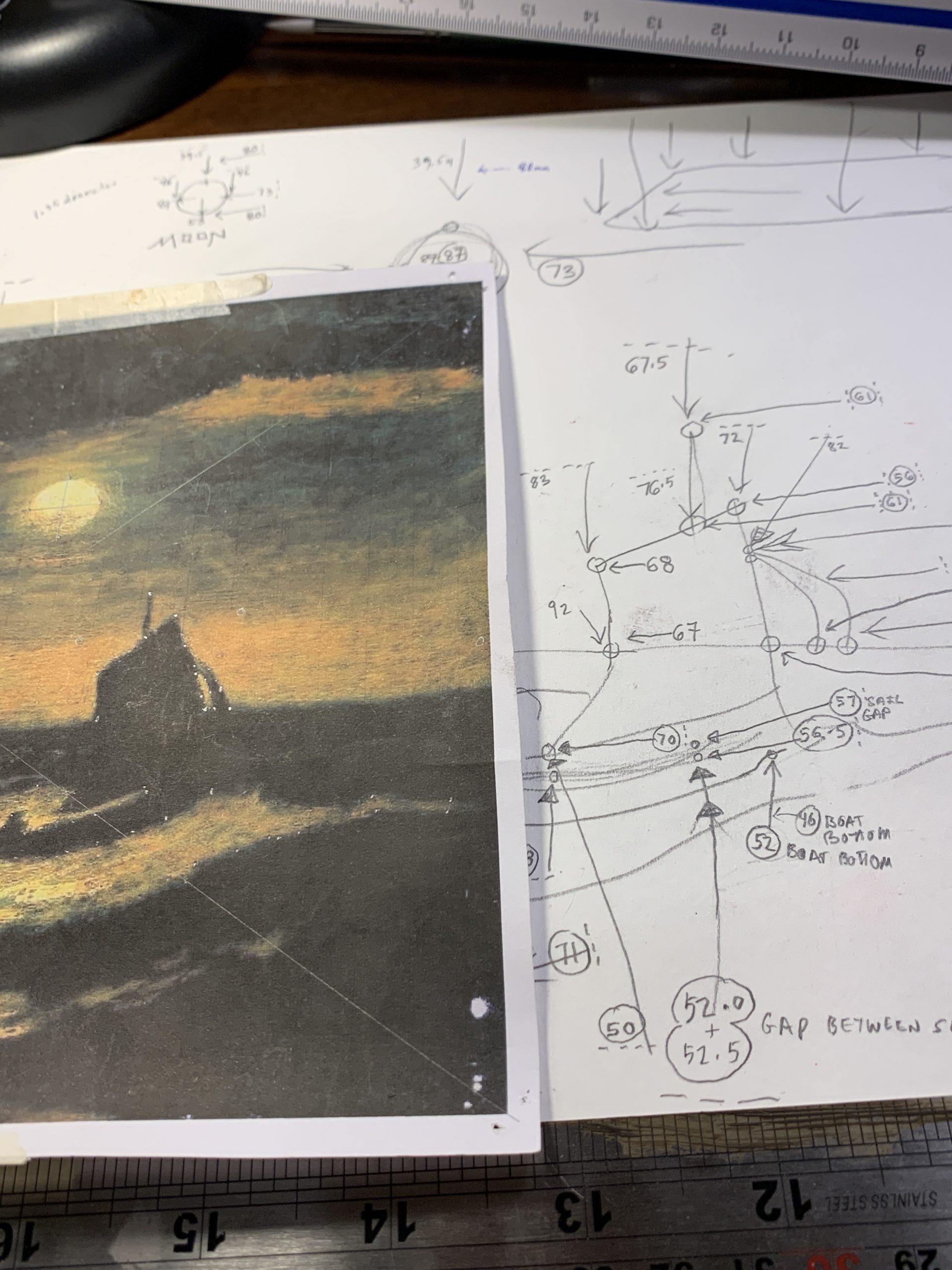
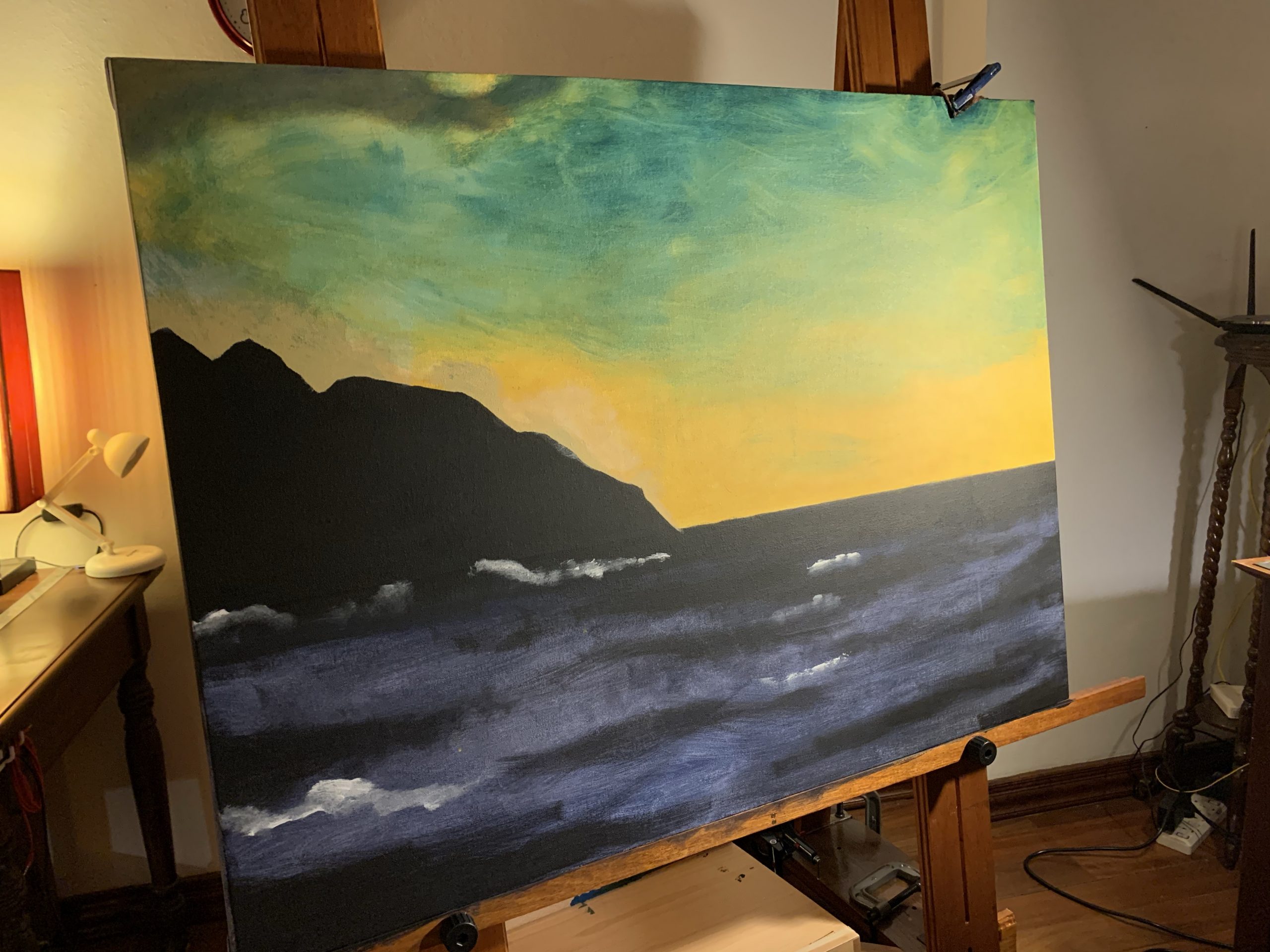
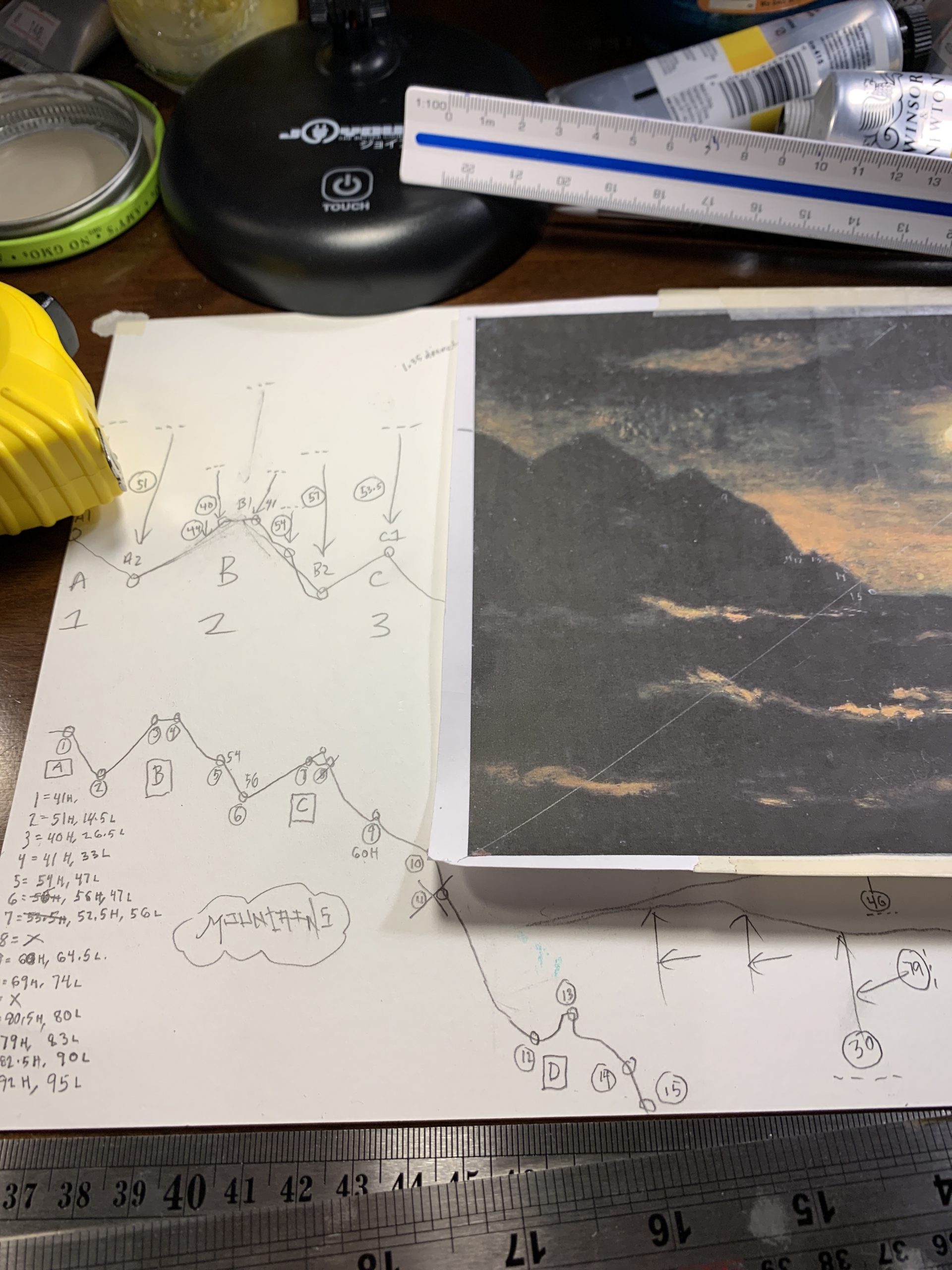
I was able to spend a Sunday afternoon with my daughters in the studio and while they drew their stuff I was able to map out the coordinates of the objects in this painting.

It is painstaking work but I am learning a lot about how this painter arranged everything.

The sketching might look a bit haphazard but don’t let that fool you the coordinates are accurate to the millimeter.
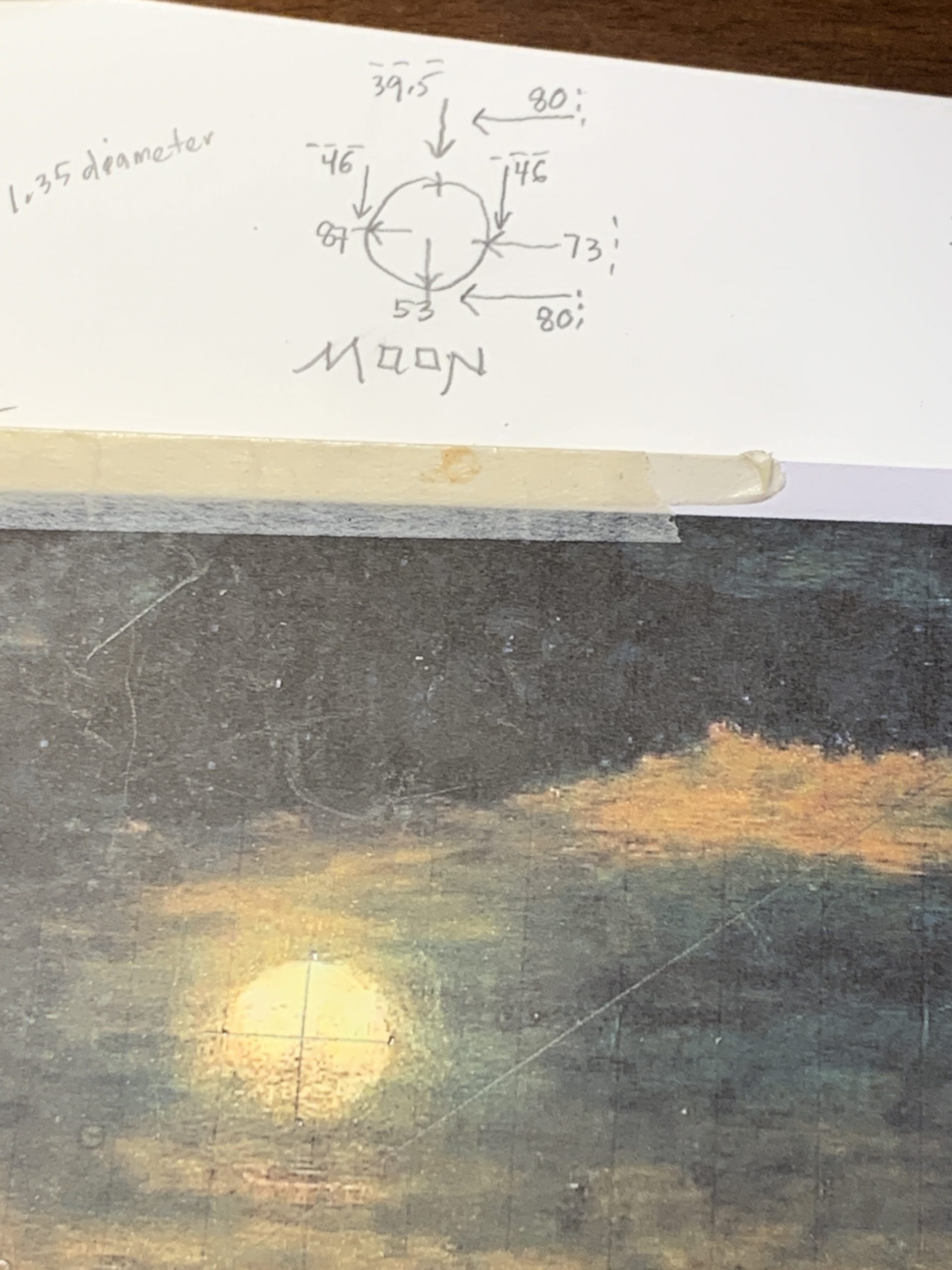
I was able to get the diameter of the moon as well as it’s X and Y coordinates otherwise known as latitude and longitude.

There is a technique to do this which I will describe in a separate article so that you do not have to use an opaque projector.

I was also able to get the X and Y coordinates of all the mountain peaks and cliffs, as well as the position of the sailboat and it’s orientation above, at, and below the horizon line, and the perceived shoreline, @ viewer position.

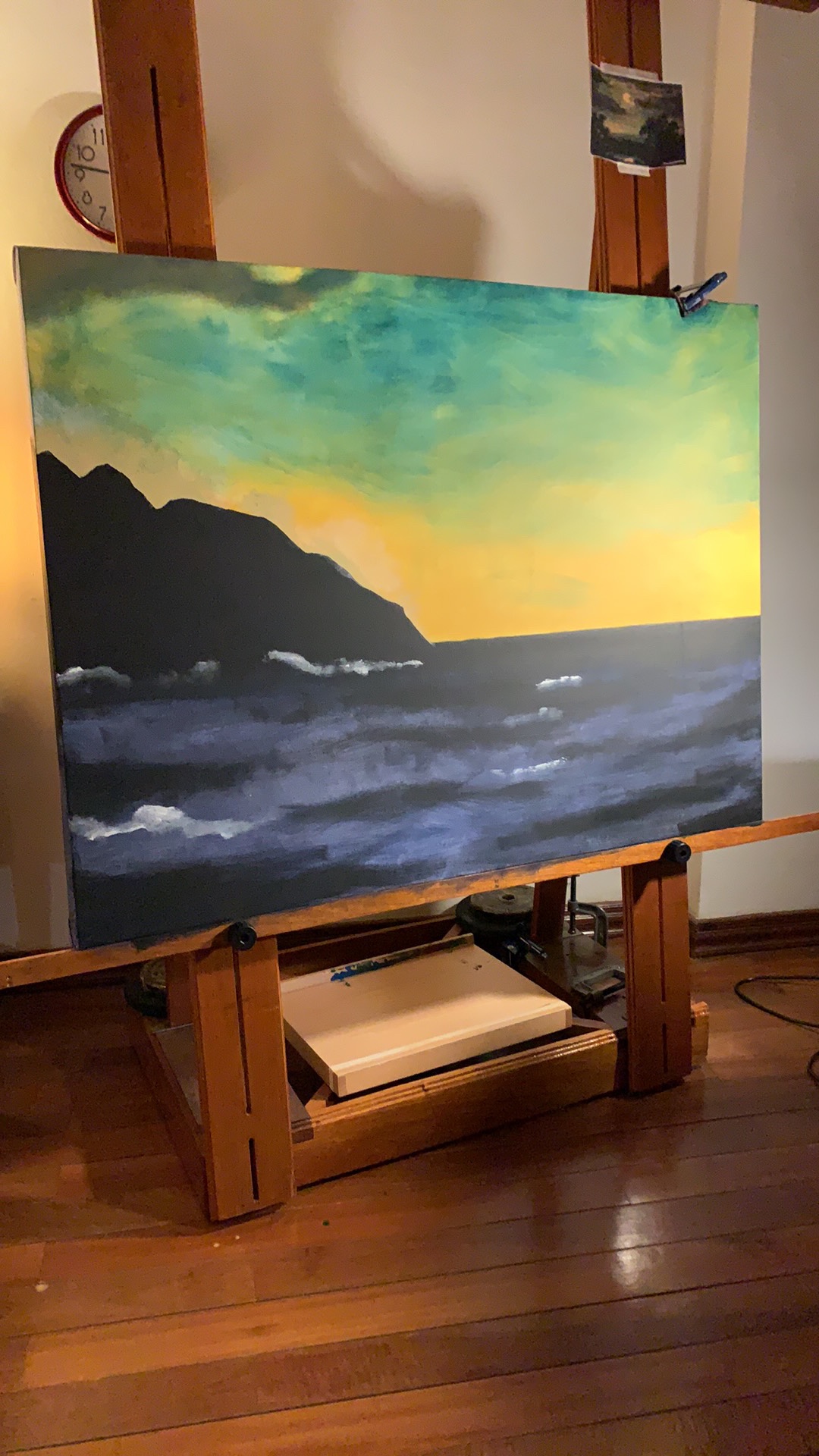
I have actually rendered the basics of the moon and the top mast and main sail. They came up in pretty accurate position all things considered.
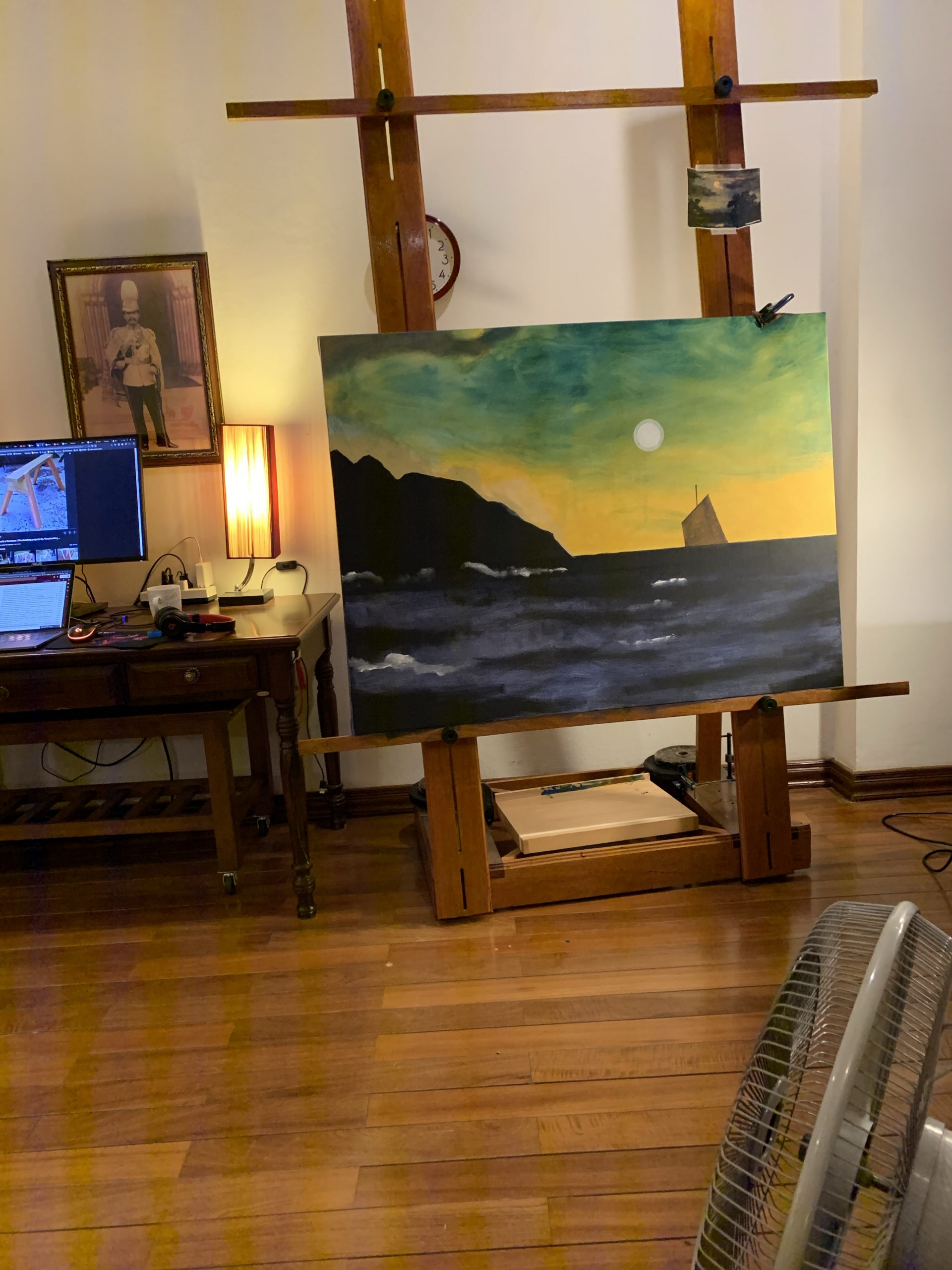
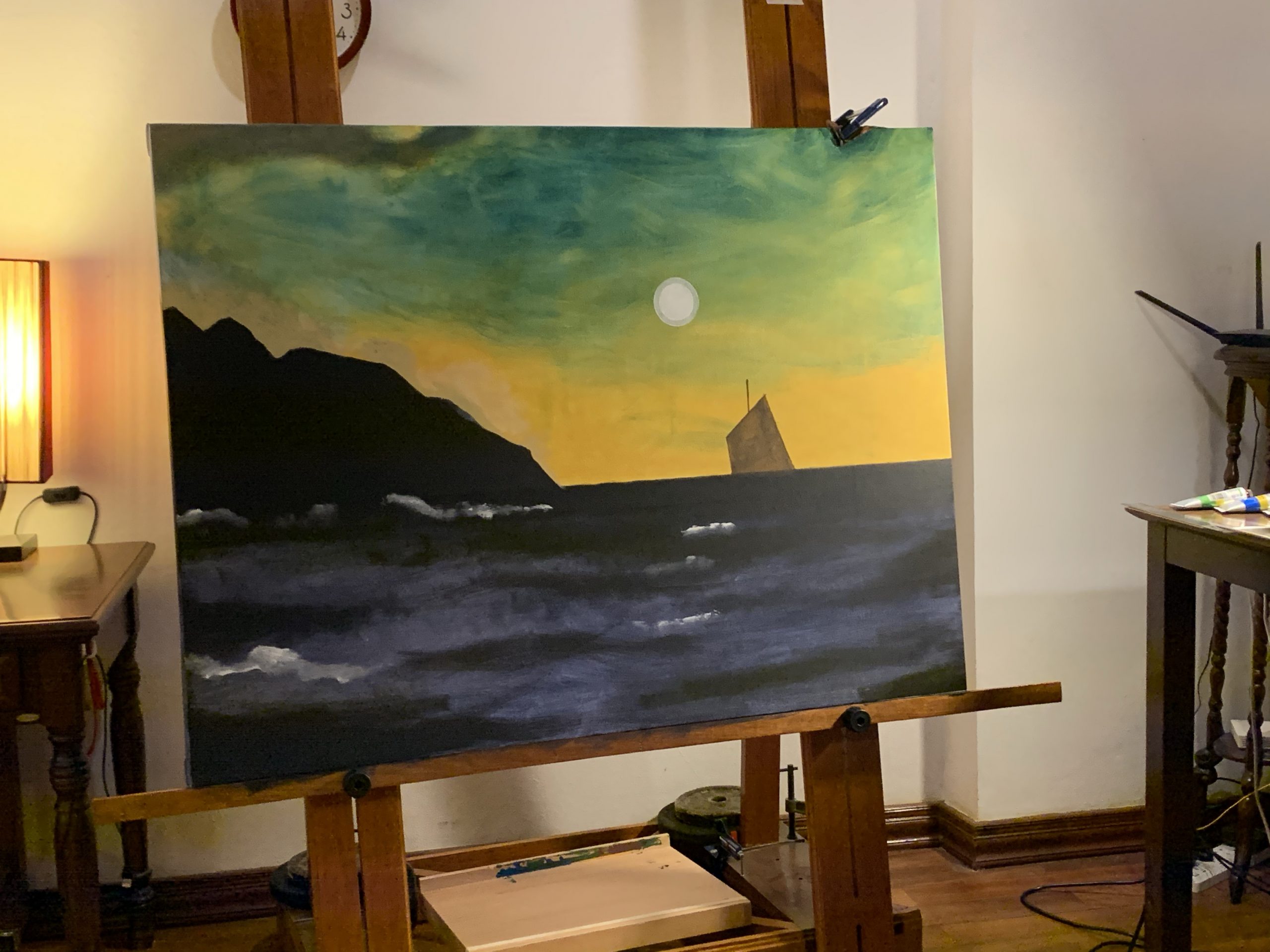
This canvas is exactly 583x the scale of the reference drawing.

I am using Google sheets to convert X height from top edge and Y width inwards from right edge for the bottom right corner of the main sail where it meets the horizon line.

Here’s the coordinate in original (reference drawing in cm.m and it’s converted scaled value (on canvas) in cm.m.
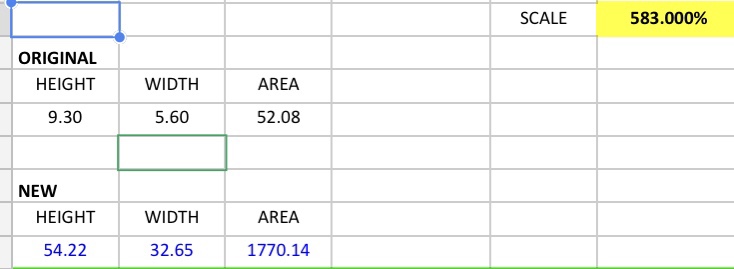
As noted above I will share the exact technique for this process most likely in a YouTube video once I get the script written.

I’d also like to give credit to my engineer friend JD in the video as well as the corresponding web posting for coming up with the simplest formula in answer to an email I wrote him.

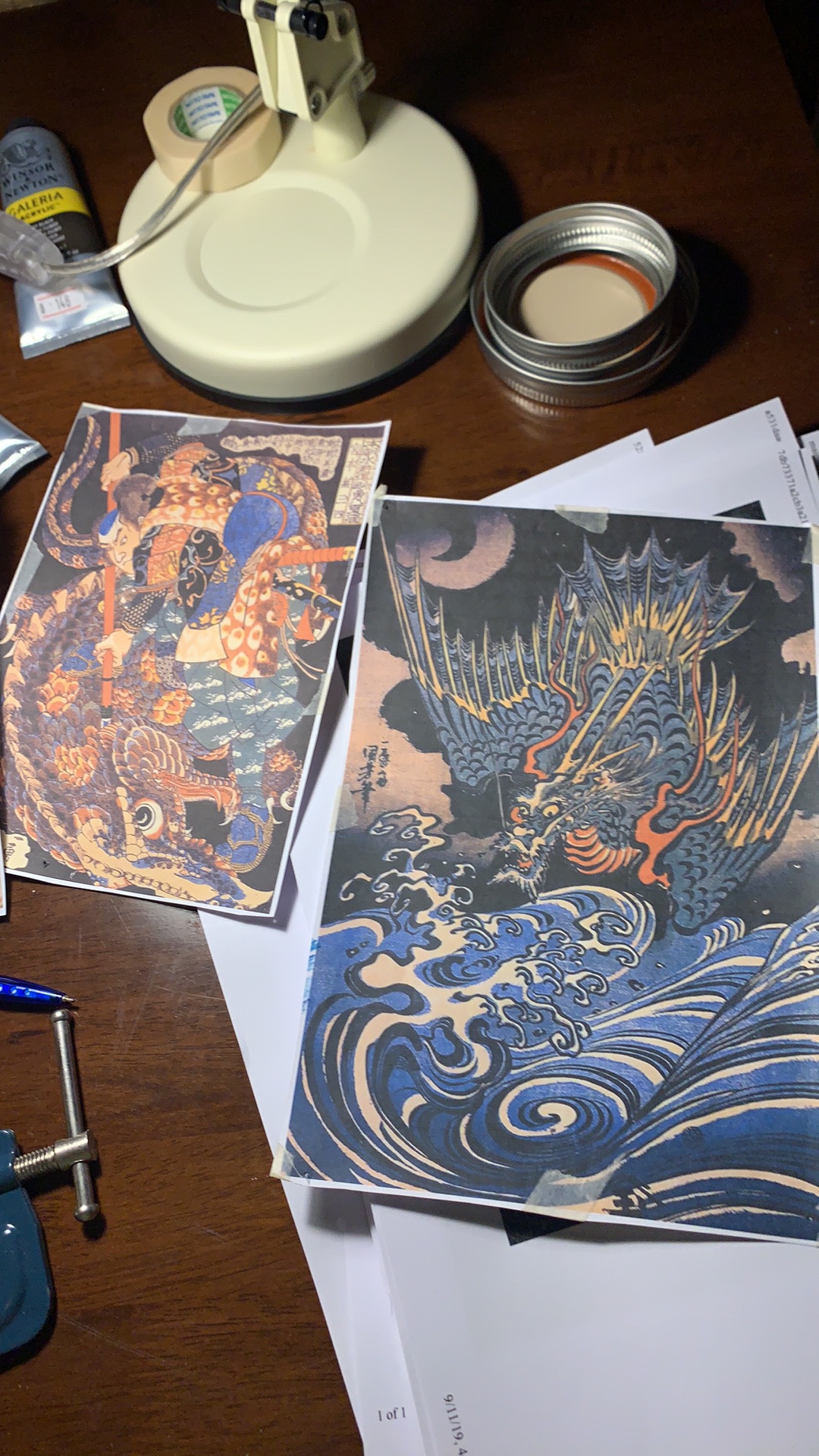
You might ask: “why study another artist?”

My best answer is that with regard to oil painting there are quite a few related disciplines within fine arts and illustration that lead to solid work versus days weeks or even months of constant reworking of mistakes.

In oil paintings the chemistry of each layer has to relate properly to the layers around it above it and below it. The chemistry of the oil paint out of the tube differs from color to color due to the chemical elements used to manufacture the given color. Also within the tube there are several other ingredients which also differ in terms of how they dry, shrink, bleed, and otherwise interact with neighboring colors.

And that’s just the color in the tube, without regard for the solvents used, or expanders used, such as Linseed Oil, or stand oil.

So the technical answer to why study someone else’s work in this particular post is given with the reader also keeping in mind that this work is being done presently in acrylic to rule out the chemistry of oils and just focus on the other part of the answer which is one of drawing and perspective, positive and negative space, color, light, shadow, and other factors.

Starting out with an artist who has done work that can be studied easily as a way to build up all of the skills and gain an understanding everywhere needed in technical and chemistry areas. 

There is also quite a bit of aesthetic enjoyment as one begins to solve the hidden formula with regard to how the artist laid out this work overall. 

All of this contributes toward a future understanding of how to produce original independent work of one’s own that contains all of the more advanced skills one would need to impress an audience or get a message, impression, concept or mood across.

My answer might not be good enough for some people but consider it from another angle: That of an architect, that of a chef, that of a pilot, or even that of a brain surgeon. Or even simpler a student driver of a car, in a given city.

You can’t just hop into a car and go to a specific destination if you’ve never driven before. You can’t design a building, bake a cake, fly an airplane, or do brain surgery without studying.

The same applies with regard to drawing and painting and learning from the Masters. There are many reasons why their work was considered superior even centuries after they passed on. One would do well to understand the accomplishments of those who came before them.

It’s not a matter of loyalty, it’s a matter of detail.

One must practice in all disciplines, even the most simple. Practice builds experience and situational awareness.

While some regard to fine arts as a play pen, I regard them as a place where many different scientific, mathematical, and aesthetic devices come into play.

Be it chemistry of light and color with regard to working with dyes, pigments, inks or paints, or the mathematics of geometry (perspective) or the basic algebra of calculating latitude and longitude coordinates at multiple scales or units of measurement, or the aesthetic and creative endeavors of inventing three-dimensional spaces in which one can render anything, -these are my preferred, perhaps “old-fashioned”, yet to me more rewarding and “grounding” pastime, than what I had been spending time on prior, e.g. the Internet.

I am dictating this text into a mobile phone and apologize for the grammatical structure of my spoken words.

But I hope some of the answers or input have given might be understood by any reader who might be interested in similar work.

Or why I might have moved on from being quite involved in my former multi-decades career as an Internet publisher, Linux / UNIX Systems Engineer / Admin, Database Administrator, Network & Security Expert, some-time Coder.

If you are too old or poor or unconnected to study astrophysics, perhaps the rigors of fine art might be a suitable Haven.
Filed Under: Acrylic Paintings, Albert Pinkham Ryder, Fine Arts

Miyamoto, Siqueiros, Orozco,Horta?

March 2, 2020 by blogadmin

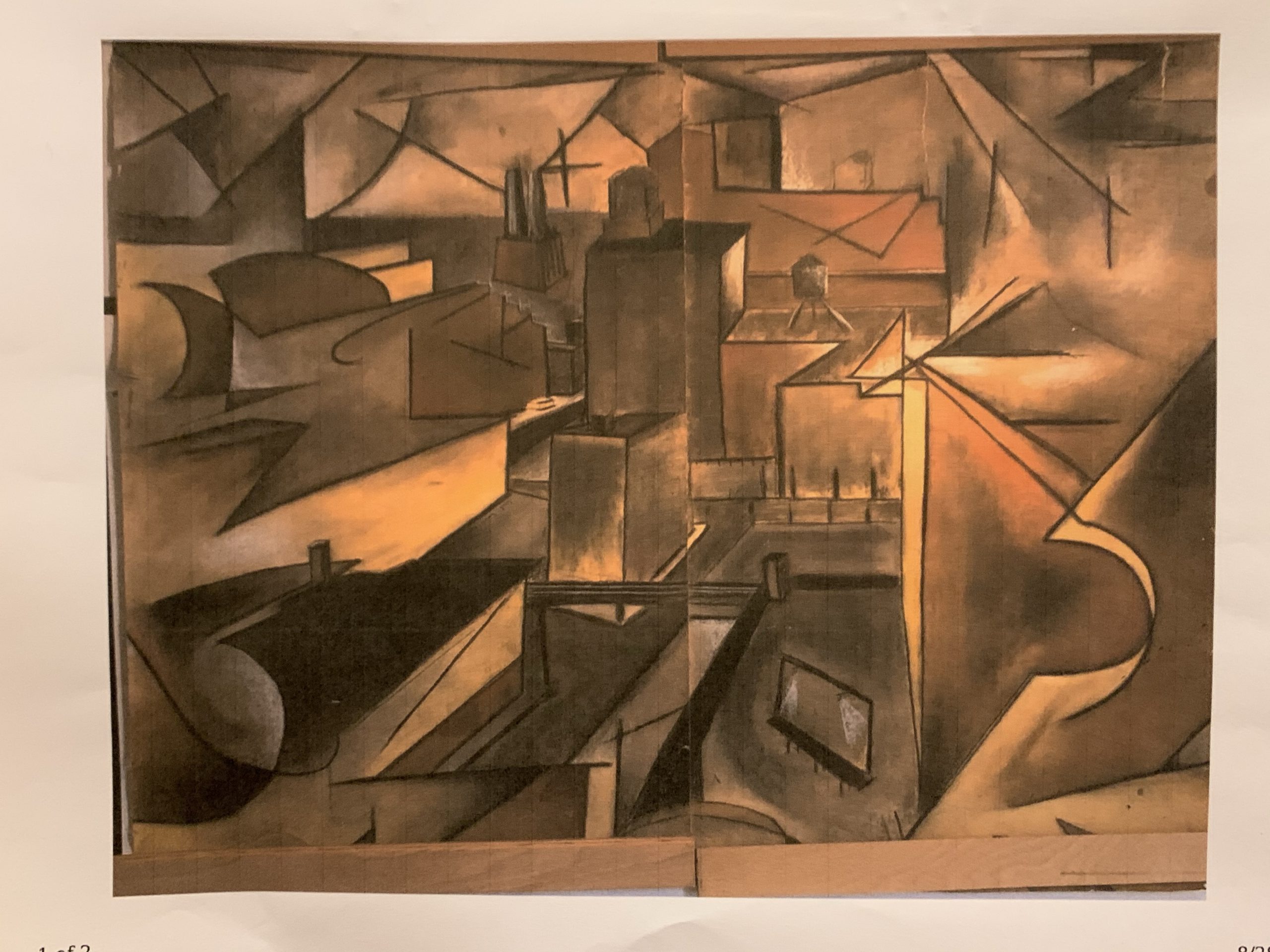
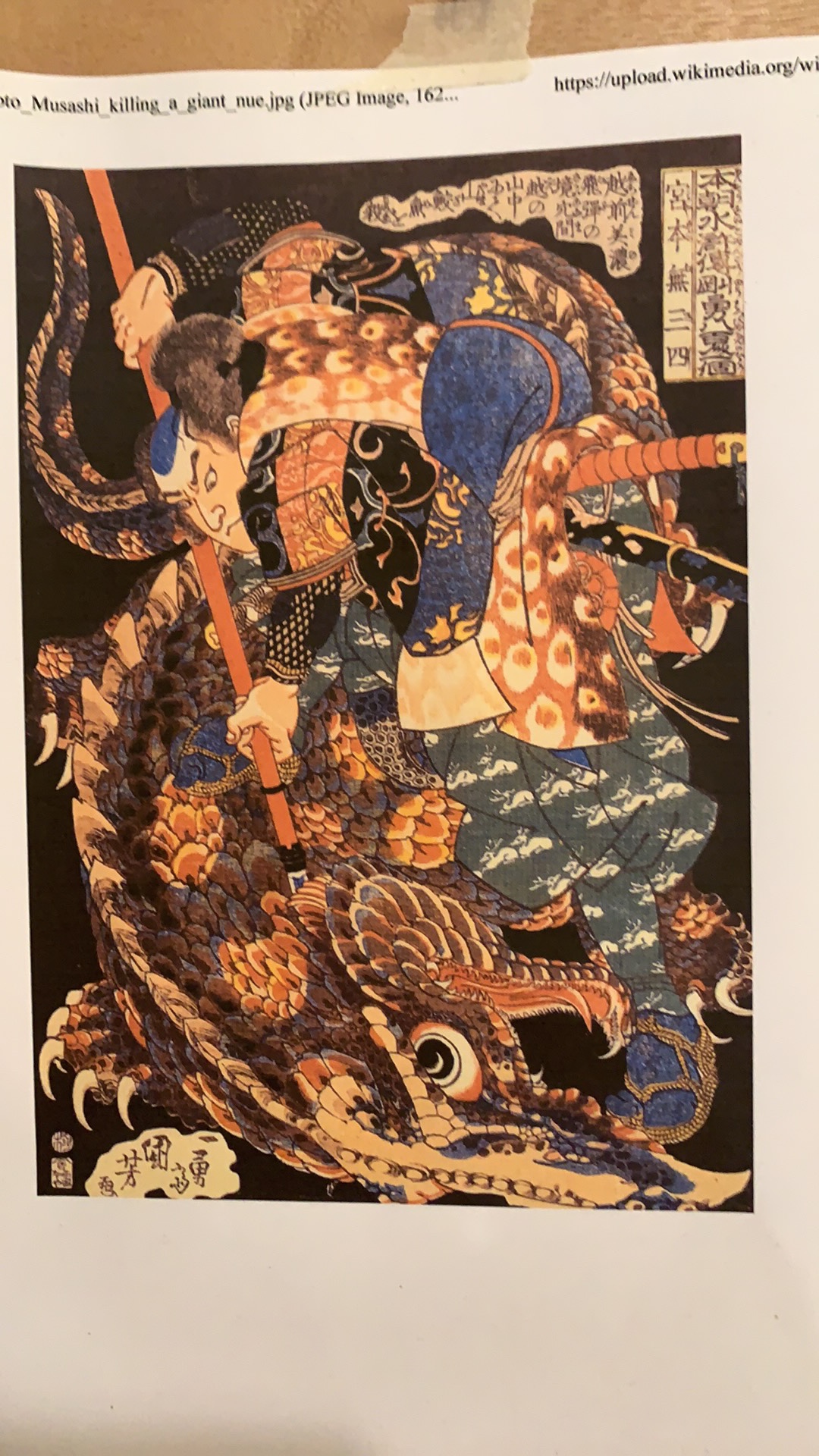
In the effort to add one more work on to the newest easel I am wondering which Japanese master to study.

Or should it be David Alfaro Sequiros?

Orozco?

Or Victor Horta?

David Alfaro Sequiros, "The Elements"

David Alfaro Sequiros, “The Elements” 1425 px x 1789 px

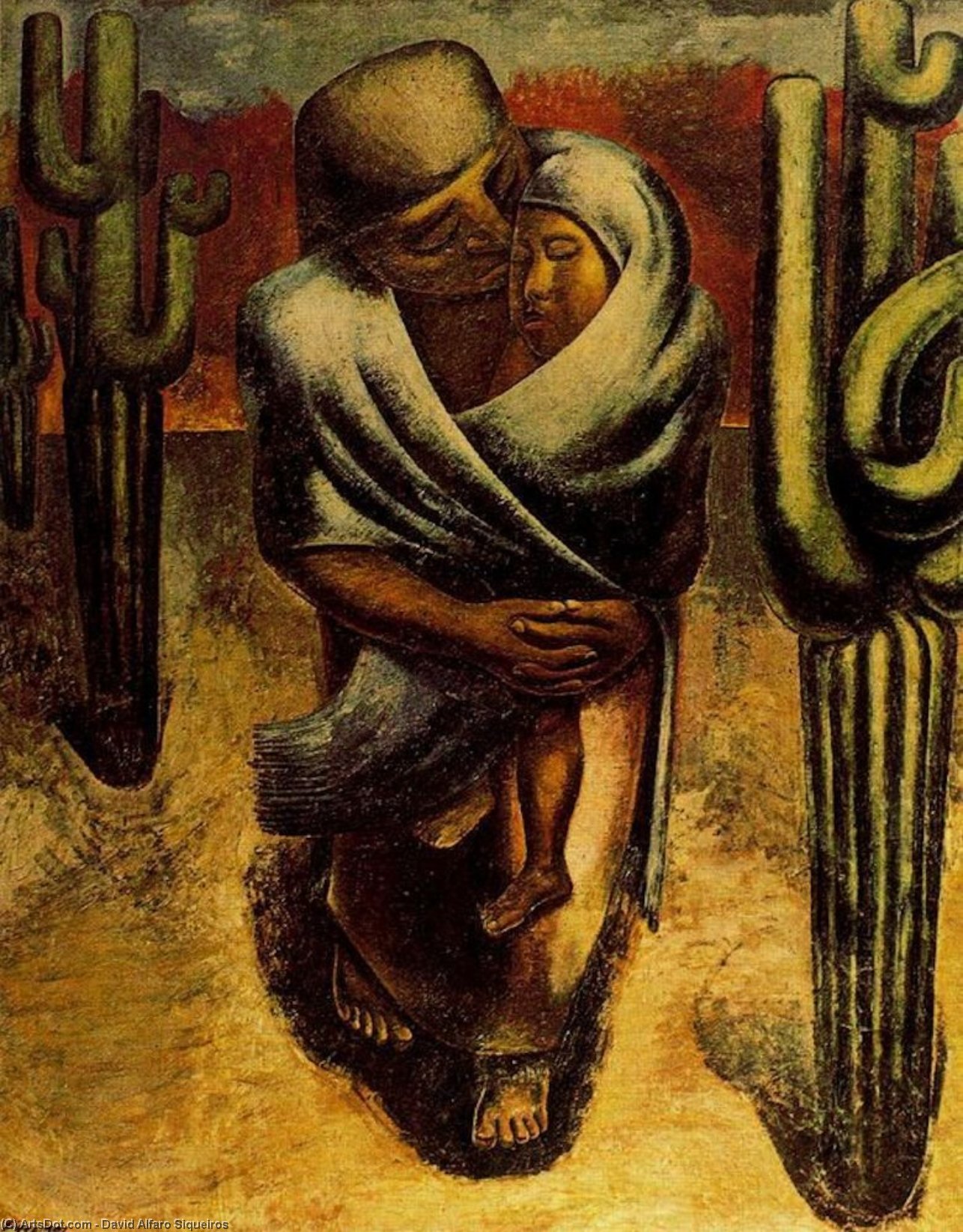
David Alfaro Sequiros "Peasant Mother"

David Alfaro Sequiros “Peasant Mother”, 1286 px x 1645 px


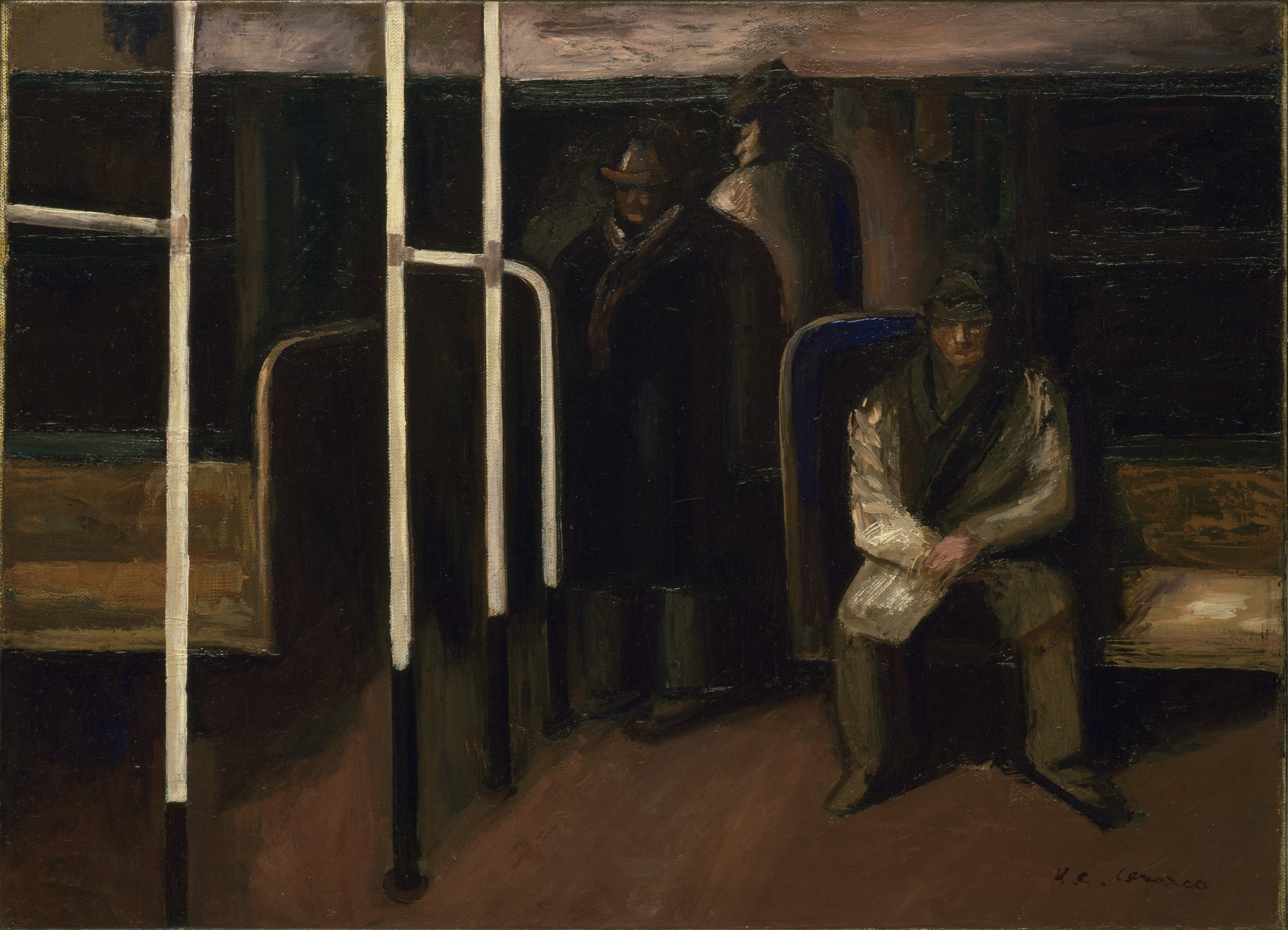
Jose Clemete Orozco, "The Subway"

Jose Clemete Orozco, “The Subway” 2000 px x 1444 px

Filed Under: Acrylic Paintings, Fine Arts, Oil Paintings

Silver Moon: Update 2/29/20

February 29, 2020 by blogadmin

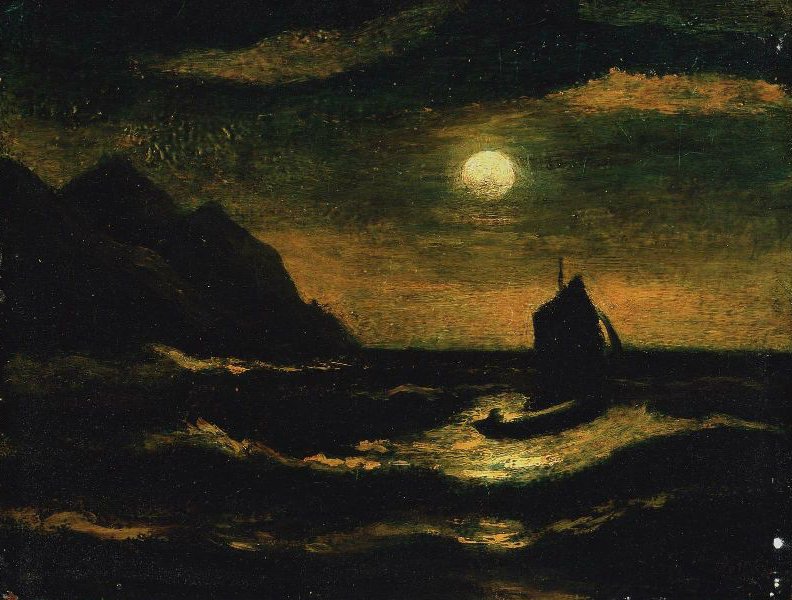
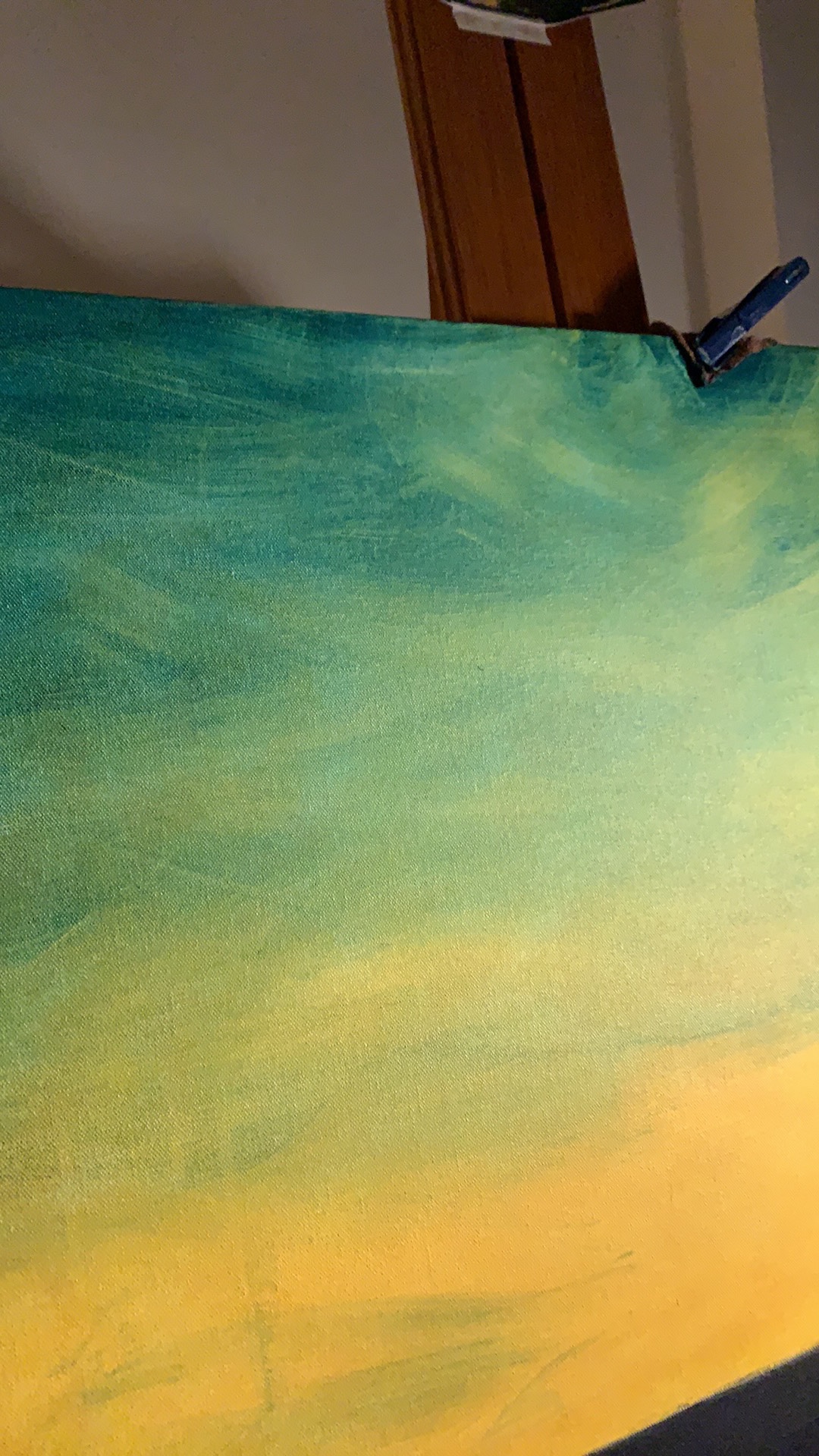
I got this work a little bit further along and I’m only loosely following the original.

Albert Pinkham Ryder Silver Moon

Albert Pinkham Ryder Silver Moon 792px x 600px

This time I was able to get a wash on there which was almost forgotten scale until I came back into my mind while rendering the sky.

Filed Under: Acrylic Paintings, Albert Pinkham Ryder, Artists, Fine Arts Tagged With: Albert Pinkham Ryder, Fine Art, Moon, Night, Oil Painting, Sea, Ship

SCI-NEWS.com

  • 125-Million-Year-Old Crocodile Relative Reveals Its True Colors
    by Enrico de Lazaro on June 18, 2026 at 11:48 pm

    Exceptionally preserved skin of Montsecosuchus depereti, an extinct crocodylomorph no larger than a house cat that prowled the tropical wetlands of Early Cretaceous Spain, has allowed paleontologists […]

  • CERN Physicists Discover Third and Final Member of Doubly Charmed Baryon Family
    by News Staff on June 18, 2026 at 6:13 pm

    Physicists with LHCb Collaboration at CERN’s Large Hadron Collider (LHC) have detected the elusive Ωcc⁺ baryon, a particle containing two charm quarks and one strange quark, completing a […]

  • Scientists Use Math to Solve Viral Word Game ‘Wordle’ with 99% Success Rate
    by News Staff on June 18, 2026 at 5:09 pm

    Researchers at Binghamton University have applied a 70-year-old theory of information to the viral word game Wordle, revealing how a carefully chosen first guess can dramatically improve a player’s […]

  • Consciousness is Not Exclusive to Earth’s Biology, Philosophers Argue
    by Natali Anderson on June 17, 2026 at 10:48 pm

    University of California, Riverside’s Professor Eric Schwitzgebel and University of Lisbon postdoctoral researcher Jeremy Pober argue that consciousness is substrate flexible, meaning it can arise […]

  • Astronomers Find Four Separate Generations of Stars in ‘Globular Cluster’ Terzan 5
    by News Staff on June 17, 2026 at 10:08 pm

    New Webb and Hubble data not only confirm the existence of two distinct populations of stars in the ancient stellar system Terzan 5, once classified as a globular cluster, but also provides evidence […]

  • Astronomers Trace Elusive High-Energy Neutrino to Star-Forming Galaxy in Early Universe
    by News Staff on June 17, 2026 at 7:48 pm

    JCMT0402-0424, a dusty starburst galaxy around 11 billion light-years away, is the strongest candidate yet for the source of the high-energy neutrino event IC 210922A, according to a team of […]

  • Radar Observations Reveal New Clues about Europa’s Hidden Interior
    by News Staff on June 17, 2026 at 6:57 pm

    Using NASA’s Goldstone Solar System Radar and NSF’s Green Bank Telescope, astronomers from the University of California, Los Angeles, confirmed that the icy surface of Jupiter’s moon Europa […]

  • New Supernova Study Confirms Universe’s Expansion is Still Accelerating
    by News Staff on June 17, 2026 at 4:04 pm

    A fresh analysis of Type Ia supernovae overturns a controversial 2025 claim that cosmic expansion is slowing. The post New Supernova Study Confirms Universe’s Expansion is Still Accelerating […]

  • New Duck-Billed Dinosaur Unearthed in Romania
    by Enrico de Lazaro on June 16, 2026 at 9:19 pm

    An international team of paleontologists from Romania, Hungary and Italy has identified a new genus and species of herbivorous, duck-billed dinosaur from an incomplete skeleton unearthed in the […]

  • New Species of Walking Shark Discovered off Papua New Guinea
    by Natali Anderson on June 16, 2026 at 7:51 pm

    Marine biologists have identified a new species of the shark genus Hemiscyllium in the waters of eastern Papua New Guinea, expanding a remarkable group of reef-dwelling sharks known for using their […]

  • Evidence of Fire Use by Early Humans May Date Back Nearly 1.8 Million Years
    by Enrico de Lazaro on June 16, 2026 at 4:38 pm

    Scientists have uncovered compelling new evidence that early human ancestors, likely Homo erectus, were deliberately bringing fire into Wonderwerk Cave in South Africa as far back as 1.79 million […]

  • Fossils from Chinese Cave Fill Crucial Gap in History of Gigantopithecus blacki
    by Sergio Prostak on June 15, 2026 at 8:38 pm

    Deep inside a limestone cave in southern China, paleontologists have uncovered an assemblage of thirteen fossilized teeth belonging to Gigantopithecus blacki, the largest primate species ever known […]

  • Experimental Copper-Based Drug Clears Alzheimer’s Plaques and Boosts Memory in Mice
    by News Staff on June 15, 2026 at 6:53 pm

    Copper diacetyl bis(4-methyl-3-thiosemicarbazone), or Cu(ATSM), restored a key waste-removal system in the brain, reducing toxic amyloid-beta buildup and improving spatial memory in lab models of […]

  • New Marsupial Lineage Emerges from Australian Fossils
    by Enrico de Lazaro on June 15, 2026 at 5:36 pm

    Paleontologists have described a new genus and three new species of small, insect-eating marsupials from the Early Miocene deposits of the Riversleigh World Heritage Area in northwestern Queensland, […]

  • Eliminating Sucrose from Low-Fat Diet Alters Gut Microbiome, Animal Study Suggests
    by News Staff on June 15, 2026 at 3:49 pm

    In a mouse study conducted by scientists at the Dasman Diabetes Institute in Kuwait, rodents fed a sucrose-free diet developed insulin resistance, gut microbial imbalances and signs of fatty liver […]

  • Webb Delivers Strongest-Ever Case for ‘Black Hole Stars’ Lurking in Early Universe
    by Enrico de Lazaro on June 15, 2026 at 2:00 pm

    Using Webb’s NIRCam and NIRSpec instruments, astronomers have obtained the deepest spectrum ever taken of a little red dot. The post Webb Delivers Strongest-Ever Case for ‘Black Hole Stars’ […]

  • Entomologists Reconstruct Evolutionary History of Millipedes
    by Natali Anderson on June 14, 2026 at 12:51 pm

    Two elusive groups of millipedes, Siphoniulida and Siphonocryptida, were the last missing pieces in the evolutionary history of Earth’s oldest land animals, according to a team of entomologists led […]

  • Astronomers May Have Found Supernova Remnant near Milky Way’s Central Black Hole
    by News Staff on June 12, 2026 at 3:43 pm

    Using NASA’s Chandra X-ray Observatory and ESA’s XMM-Newton satellite, astronomers identified a possible remnant of ancient stellar explosion just a few dozen light-years from Sagittarius A*, a […]

  • New Species of Ancient Bear-Dog Identified in Spain
    by Natali Anderson on June 11, 2026 at 9:46 pm

    Paleontologists have identified a previously unknown species of amphicyonid -- the extinct family of carnivorous mammals popularly known as bear-dogs -- from two specimens unearthed at a rich fossil […]

  • Amazon’s Elusive Short-Eared Dog May Be More Common than Researchers Once Thought
    by Natali Anderson on June 11, 2026 at 7:34 pm

    Hundreds of camera-trap records from Bolivia and Peru suggest the short-eared dog (Atelocynus microtis), one of the world’s least-known canids and one of Latin America’s least-known carnivores, […]

Copyright © 2026 · Dynamik-Gen on Genesis Framework · WordPress · Log in